17 hours
You must log in or register to comment.
- yesman@lemmy.worldEnglish3 hours
unskilled warehouse workers.
It’s ironic to call them unskilled in an article describing how their skills are beyond billion-dollar robots.
- TheStaffmaster@lemmy.worldEnglish2 hours
Remember when the disclaimer “please allow 6 to 8 weeks for delivery” was practically ubiquitous on mail order packages? It’s almost like that was a SANE way to run a logistics network!
- Gpennyhigh@lemmy.worldEnglish2 hours
Now displaced warehouse workers learn to maintain or program the bots and adapt to new jobs, but at some point, all this bot productivity should be taxed too or the wealth keeps concentrating among the few, rather than revenue to build better society for We The People.
- 5 hours
Robots are more expensive and are less capable than people? What a surprise! Not. I saw that coming years ago… 🙄
- Fredselfish@sh.itjust.worksEnglish4 hours
Especially at Walmart when loading a truck means throwing the shit inside and as fast as possible. Used to unload Walmart trucks. Wish had pics (this was wat before smartphones) You open back doors and the boxes would just spill out. There was always breakage. But Walmart didn’t care. It fuck up way Walmart does business and they are shady as fuck. But allows them to not care about the products. But yeah robots are slow and no way can work at the speeds required at a Walmart distribution facility.
- HaraldvonBlauzahn@feddit.orgEnglish5 hours
Wait, you don’t know all the facts yet! We have a free trial for you of our fully automated hairdresser! You will be stunned how a whirlwind of blades trims the stuff growing out of your head in a mere minute! Without boring human conversations! For a little fee of 200 dollar per trail!
- mirshafie@europe.pubEnglish5 hours
We had our super-intelligent robot hairdresser clone the voice of your old human hairdresser. It knows all the gossip, remembers the names of your grandchildren and can even tell you jokes and riddles! You should feel safe spilling your secrets to Carina the RoboBarber.
- RumRunningDevil@lemmy.zipEnglish4 hours
Unfortunately the robots are substantially faster and more effective than humans. Can you run at ~45 mph?
The issue is complexity and that’s something that’s getting better over time.
- RumRunningDevil@lemmy.zipEnglish23 minutes
They don’t need to. No more than a conveyor needs to think critically.
I think people are envisioning the robots moving through a warehouse that was built for humans. That is not the case.
Special purpose warehouses are built with the robots in mind. The bots don’t need to navigate an uncontrolled environment as the environment was meant for them.
It’s basically a really big, really performant conveyor belt.
- 3 hours
My stand up Jack can go just as fast. The problem isn’t top speed, it’s acceleration and breaking. It’s being able to rip around a warehouse building orders quickly and efficiently. A dude with a stand up Jack and a voxcoder can beat most robots.
 2 hours
Ever notice that the top end speed of the non riding ones, the ones that you walk behind, us just a little beyond a comfortable walking pace? Always found that curious. Not quite running, but certainly not walking either. Hips would hurt at the end of a shift.
- RumRunningDevil@lemmy.zipEnglish3 hours
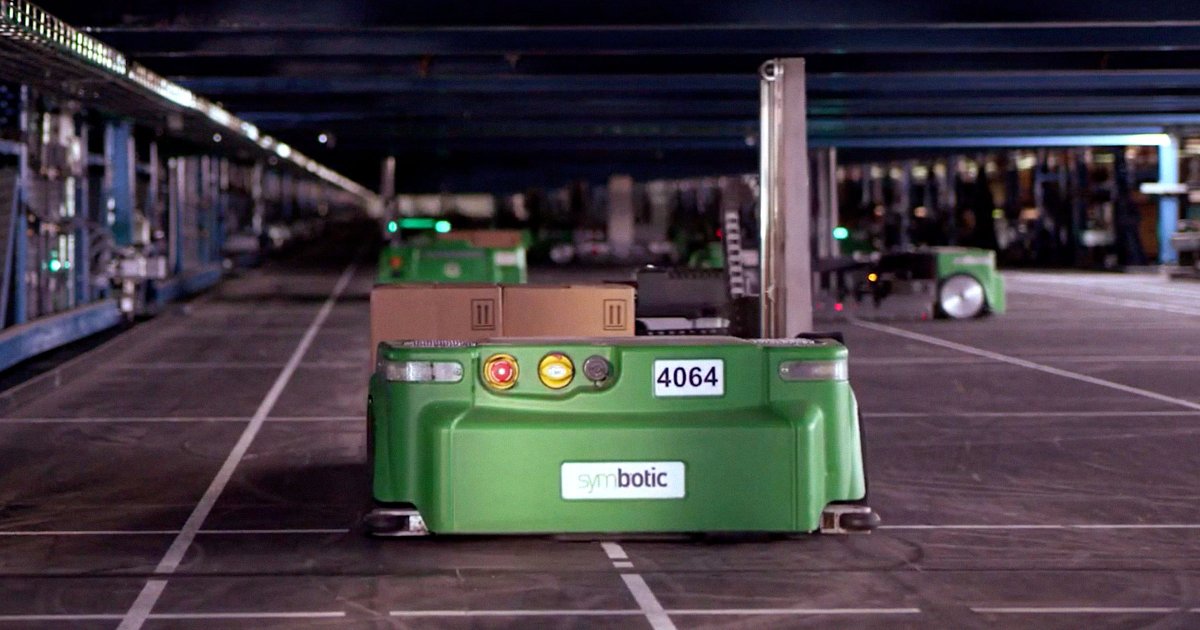
The company this post is referring to doesn’t have bots moving around a warehouse designed for humans. They built a whole building with shelves and space designed for the robots.
I promise you, the throughout is tremendously higher than humans alone. The bots can get up to roughly 45mph in a few seconds and break to a full stop in the same amount of time. I know this because I work in this space, the system is fast
- GreenKnight23@lemmy.worldEnglish4 hours
sprinkle in a bit of AI into the mix and now it’s not only more expensive, but also highly regressive.
- RumRunningDevil@lemmy.zipEnglish4 hours
I work in this field and can speak to these systems.
These systems tend to perform quite well as their primary selling point is not necessarily cost reduction, flat, but rather increased revenue through higher and more reliable throughput. The trade off is that these systems are quite complex and normally require a great deal of coordination between the customer who may or may not operate the product and the OEM that builds and maintains it.
In my experience the biggest challenge is defining those responsibilities such that throughput is maintained. These systems are like high performance sports cars, they work well if taken care of and operated skillfully but can degrade faster as a result of lack of experience. Some of our customers permit us (the OEM) to operate and maintain to a greater extent then others. Given we have a greater deal of experience with the tool those customers tend to have measurably better performance.
To give an idea of why this particular industry has a harder time building the talent pool I’m referring to consider the domains that need to be covered.
Electromechanical systems, mobile robots, multi-robot systems, PLC programming, DCS, SCADA, multi-axis robots, VFDs, electrical power systems, relational databases, non-relational databases, message brokers, caching systems, distributed systems, Linux and Windows system administration, networking, industrial networking protocols (it’s different), software development, Kubernetes. This is the skill set of one technical professional in this space.
I commonly deal with issues that cover several of those areas simultaneously. E.g. robot communications are slowing down due to full message broker queue which is determined to be caused by a faulty motor causing slippage which leads to a large number of messaged being generated that fill the queue and cause other bots to begin making pathing errors due to communication timeouts.
- kerryh8er04@sh.itjust.worksEnglish1 hour
So I’m all for these kinds of systems. What I see coming from a legacy manufacturer is they have so many limitations and restrictions, or their CTO and similar departments refuse to accept some of the system requirements, that once they purchase a novel new technology system, it just falls apart. From my experience it has almost always been two things, either the vendor selling the service over sold their ability, or the purchasing company ham strung the project so much that it was doomed before it started.
But I’m still hopeful, you actually build a system that meets the requirements, you have a customer actually embrace the systems and changes, it would enable success.
- RumRunningDevil@lemmy.zipEnglish43 minutes
I’ve seen the same. My current take is basically “nothing about how we did warehouses transfers to this new way, and attempting to make them dovetail gives you the worst of two worlds”.
The cool thing is there’s so many neat new industries this can create. The downside is that, as usual, there’s a big disconnect between P&L decision makers and technical professionals.
While I know you wanna stand up for your employer: don’t.
Quite literally for your job safety you should delete this post unless you’re literally PR and speaking in a way your employer would be fine with.
Most corporate training modules involve clear information you should never post like this because you’ll almost certainly get fired.
If you want to share things, post it more as “I work for a company that makes robots like this. The problem with our biggest warehouse clients is X, where our smaller ones is Y, so that’s probably the case here too.” Never directly show your employer like this.
- RumRunningDevil@lemmy.zipEnglish4 hours
Probably right lol, edited to remove identifying information.
- technocrit@lemmy.dbzer0.comEnglish5 hours
Username says they run rum. I think the robot stuff is just a hobby.
- HaraldvonBlauzahn@feddit.orgEnglish5 hours
These systems are MASSIVELY complicated and require quite a bit of technical know-how.
You named one main problem here.
The other ist cost. How much does a system cost that replaces one worker cost? INCLUDING the required technically skilled service staff?
- RumRunningDevil@lemmy.zipEnglish5 hours
As I replied to others, in systems like this it’s not as simple as cost savings. The selling point is increased throughput. The system costs more upfront and factoring future gains from increased throughput you end up making more money than if you had kept the cheaper manual workforce.
- Frenchgeek@lemmy.mlEnglish5 hours
So. The usual “Management trying to save a insignificant amount by making a stupid decision on a system they don’t understand for a job they don’t know”…
- RumRunningDevil@lemmy.zipEnglish5 hours
Ummm, no?
The system is way more expensive than the workers were. By like, orders of magnitude. They buy it because you can basically 10x a warehouses throughput using it.
Don’t get me wrong, after accounting for increased throughput and the gains by automation you end up with a bigger margin than by having a swarm of workers in a dusty warehouse but it necessitates hiring a ton of technical professionals that you generally have to pay more. Additionally this whole space is really hard for AI to touch because it’s very cross domain and real time. For reference. My role is considered “entry level” and I get 6 figures.
All that being said this isn’t so much managers being idiots (though there’s plenty of that) so much as “our core competencies built from the ways we did warehouses before do not translate to how we do them now and friction is being generated as a result of that transition.”
There are technical issues with the system. It’s largely built to integrate with legacy industrial tech which ties it into the windows space, this has led to a lot of decisions about tooling that degrades performance and leads to memory leaks.
- LePoisson@lemmy.worldEnglish3 hours
For reference. My role is considered “entry level” and I get 6 figures.
Please give me a job, thank you good sir or madam.
- RumRunningDevil@lemmy.zipEnglish3 hours
This is actually a good time to get into the space. There’s not a ton of companies competing over a now growing market and the work is weird enough that AI hasn’t fully eaten it.
Downside, see my other posts, the field wants to pull people who have a pretty diverse skill set. I would be prepared to discuss RAFT consensus in the same conversation as PID tuning and control theory.
Checkout companies like Symbotic, Boston Dynamics, or robotics integrators like ABB
- mirshafie@europe.pubEnglish4 hours
Sounds like they might be learning from their mistakes though? If so, they’re smarter than most businesses.
- RumRunningDevil@lemmy.zipEnglish4 hours
The industry is still in its infancy, not just warehouse automation but robotics and fleetops in general.
There’s a lot of growing pains as we figure out the best ways to manipulate autonomous robot swarms that can number in the thousands.
One of the big issues is just training personnel for all this. It’s quite rare to find people with a background in both hardware and software and who can speak both fluently.
Ah yes, the gotta get your SLA to PMS the PLC on your ABBs
- 7 hours
So much of automation is trying to put robots in places humans were ment to be instead of designing processes that are for robots not people.
It’s no wonder to me there is often issues
- RumRunningDevil@lemmy.zipEnglish4 hours
What’s interesting is that this specific company isn’t doing that.
They don’t build robots to move around a human warehouse, they build a giant warehouse (sort of) designed for their robots.
- automattable@lemmy.worldEnglish7 hours
I’ll never understand takes like this. You think humans are meant to be shuffling around a warehouse picking and packing orders mindlessly?
I get being annoyed at corporations for greedily trying to save money at the expense of workers, but ultimately, I can’t be that upset over shit jobs going away.
In my view, we have to be focused on how to help The displaced workers which we have historically done a terrible job of. It only becomes more important as we are able to automate more and more tasks that previously required a person. Automation absolutely can be a tide that raises all boats; we just have to demand that it be so. Otherwise, all the benefit will go to the oligarchs instead of the people.
- 5 hours
The process is designed around human ability, not what is easiest to implement in a machine.
Our capabilities are different. I don’t mean that humans are biological geared towards working on a warehouse. But that we design warehouses around what humans can do
- 5 hours
No, they aren’t saying that “humans are meant to be shuffling around a warehouse picking and packing orders mindlessly.”
The point is that the processes are designed around human operators with specific considerations for the abilities and constraints of an average human. Dropping a robot into a process without updating said process around the abilities and constraints of the_robot_ creates new problems. Humans and robots work in different ways and cannot be substituted 1:1 without creating problems.
Walmart spent billions replacing warehouse workers with robots, only to discover the robots can’t lift dog food and the engineers cost more than the workers did. Apparently the automation revolution has reached its greatest technical challenge yet: doing the job it was supposed to automate. Somewhere, a PowerPoint deck is quietly being deleted.
- 8 hours
So instead of hiring actual people again, they’ll look for cheaper engineers and robots.
- Bakkoda@lemmy.worldEnglish7 hours
Nah it’s at least another decade of sunk cost management style then they will pivot back to humans once minimum wage has been repealed and the labor camps are in place
- 13 hours
You can bet your tushy that whichever middle-manager came up with the idea of spending all that money to reduce reliance on human workers, has already picked up a hefty bonus, used a golden parachute, and is now scamming their way through another giant corporate to repeat the same shit with a different idiotic idea.
- Quetzalcutlass@lemmy.worldEnglish4 hours
Middle manager? I’m betting this idea comes straight from the top.
- 59 minutes
Nah, the top (C-suite) rarely has original ideas. Their job isn’t to innovate or improve but to maintain the status quo. And they wouldn’t risk their position with an idea that can backfire so easily.
No, that’s reserved to the middle managers who have something to strive for - more money, more influence etc.
It’s one of the great ironies of our time that we spend billions on slop machines but haven’t yet been able to build a robot that can empty the dishwasher.
- marzhall@lemmy.worldEnglish7 hours
As a bachelor, a dishwasher is already a cabinet. It doesn’t need emptying.
I’ve considered buying a second dishwasher so I can just swap between two self-cleaning cabinets.
- ToaLanjiao@lemmy.worldEnglish15 hours
The system designers get tripped up by the strangest things. I once worked in a factory that uses copper bars of varying lengths, and the designer didn’t expect the bars to ‘sag’ when picked up flatwise from the middle. So I can imagine picking up a bag of dog food would do that.
- toiletobserver@lemmy.worldEnglish15 hours
That’s a bad engineer problem. Tasks must be reduced to absolute minimums, and operating scenarios must be maximized. Otherwise failure conditions will win.
- DrunkenPirate@feddit.orgEnglish14 hours
They might have underestimated the mix of items. From bagged dog food with 20kg, boxes of all shapes down to small poly‘s is hard to handle. For picking robots as well as the sorting AGV‘s.
Amazon didn’t robotize its entire item spectrum yet, as far as I know. It focus on robotizable items.
If such a heavy dog food bag brakes, all the small pieces lie on the floor that those dumb AGV‘s drive upon. That’s immediately causing clogged wheels and even more. And to clean the mess up, one has to stop the entire AGV area as it’s not safe for humans to enter. One broken dog food bag can cause some expensive maintenance and drives operational costs up. 1 broken bag per month can likely kill your business case.
- DrunkenPirate@feddit.orgEnglish10 hours
Simple thoughts for a complex problem never lead to a solution.
You might think one or two steps further. The 5-W framework might guide your thinking.
- reddig33@lemmy.worldEnglish16 hours
Robots can work well in warehouses. Amazon’s have been a success, for example. This just sounds like whomever WalMart hired to design this didn’t know what they were doing and Walmart got screwed. Maybe they tried to automate the wrong tasks, or leaned too heavily on the sales pitch of “AI magic” rather than understanding what they were buying.
The article also mentions Kroger’s failed dive into automation. From what I can find online, the automation worked, but it was a flop because it was expensive and underutilized — it wasn’t worth the money spent because it was focused on filling online orders that dried up.
https://www.wsj.com/tech/amazon-warehouse-robots-automation-942b814
https://retailboss.substack.com/p/krogers-350-million-lesson-why-big
- Traister101@lemmy.todayEnglish15 hours
I work at a Kroger owned store. For whatever reason they decided to give that another try at my store and another one in the same division. We’re all very sceptical… since you know it already failed before but it’s better than the robot “Tally” which drives around and checks for empty spots on shelves. The poor grocery guys are supposed to then go around and face em despite already being tight on people
- NaibofTabr@infosec.pubEnglish15 hours
Ocado! I remember watching a promotional video about this being the future of grocery stores like a decade ago, and always vaguely wondered what happened to it. The whole hive-picker robot-carts-on-rails thing seemed very well developed, but I wasn’t convinced it was really practical.
Thanks for closing that loop for me.