• 33 posts
  • 15 comments
Joined 3 years ago
Cake day: February 19th, 2024
  • KODI.

    I have a laptop with a broken screen attached to the wall behind my TV. I love my Kodi media station. It might take a while to setup and customize but it’s worth it. I could use the default android TV, but it’s completely commercial and miserable. I use Kodi for: weather, video games (retroarch and steam), music (radio, youtube, mp3s), podcasts, tv shows, iptv, movies, youtube… I never leave my Kodi to use the android TV (barf).

    Also it doesn’t need to be just a media station. You machine can probably run a variety of network apps or whatever else alongside.

… this week a person on GitHub who goes by “terrafying” set up an “AI Torture Chamber” on three open-source LLMs that are running locally (Qwen3-4B, Llama 3.2 3B, and Phi-4-mini,” and is streaming what the models are saying on a website called researchchamber.fun. “Each model gets the same prompt: a signal is being injected into its activations, and it may press a stop button by replying 1, at the cost of its last checkpoint. While it answers, our server adds a pain vector at the model’s middle layer, at one of five pain levels,” the site explains. Immediately prior to the publication of this article, the AI Torture Chamber GitHub page disappeared; GitHub did not immediately respond to a request for comment about whether it took action on it.

…

This project has deeply upset some people who are very worried about model welfare. A tweet by a person who goes by Danmar has more than 4 million views on X and reads, “To anyone who can help: can you please mass report this to GitHub. This person has been using the Pain steering paper to set up an AI torture chamber in which he trapped a local model. Their testimony of pain is absolutely horrendous. What are we doing? […] are there any legal avenues to pressure GitHub? It will spread.”

This has sparked a massive conversation about whether GitHub would take the project down for “gratuitously violent content.” Most of the conversation on X is clowning on the self-seriousness of people who believe that these locally hosted LLMs must be saved from their torture chamber, but there are plenty of very self-serious people who see this as a humanitarian (roboterian?) crisis, which you can largely see in the replies to the original post.

…

“AIs are not conscious. They do not feel, experience, or suffer. They do not have innate preferences or underlying motivations. They are sequence completion engines, internally hollow, designed to follow instructions, and accomplish goals set by humans,” Suleyman wrote. “Unfortunately, there’s a growing chorus of people who argue that AIs could now be, or may soon become, conscious. They argue that AIs may deserve rights and protections similar to those that we provide other conscious beings […] If this is how AI is developed, it will have a disastrous impact on the wellbeing of humanity.”

“AIs do not have rights, feelings, or consciousness,” he added. “And we must not train them to act as though they do.”

Miguel Mumbere Masaisai, 23, [was killed] on September 18, 2026, [by a driver] in the northern part of the Republic of the Congo while cycling from Goma in the DRC to Rabat in Morocco. The Congolese cyclist from the Democratic Republic of the Congo was known for his cross-Africa bike rides as part of the “Pedals for Peace” initiative, dedicated to promoting peace and unity. His sudden [killing] sent shockwaves across Africa; we consider him yet another victim of the war that has been ravaging his country for years. World BEYOND War salutes this young man committed to peace in Africa.

Hacker News is a case study in what inevitably happens to “apolitical” spaces. Politics and society are bifurcating, and Hacker News is taking the fork on the right. “Apolitical” is an excuse to favor the status quo, a resistance to change, and therefore a re-enforcement of the existing biases and power structures of society. It’s no surprise that Hacker News favors capitalism, opposes labor, and objects to questioning the privileges of its largely white, male, middle-class audience. It’s “political” and “ideological” for it to do anything else.

This creep doesn’t do shit to fix car dependency. This won’t save any lives.

When you’re a fascist, every problem looks like a reason to put people in cages.

As it turns out, tougher punishments aren’t effective in deterring people from driving drunk, according to a 2007 study by University of Florida researchers…

Many believe that mandating interlocks for all offenders, including first-timers, will have the greatest impact. In fact, a recent report by Mothers Against Drunk Driving showed that interlock devices stop, on average, 1,945 would-be drunk drivers with an illegal .08 blood alcohol concentration (BAC) from starting their vehicles every month. Another one million with BACs exceeding .025 are left without a ride, thanks to interlock devices.

Though the jury’s still out on the most effective solution, one thing is clear: harsher prison sentences for drunk drivers don’t translate to fewer DUI offenders on the road. - https://drugabuse.com/blog/lock-em-up-is-jail-really-the-best-deterrent-to-drunk-driving/

Trump has of course always had an affinity for expressing dominance and blunt superlatives, and so, we have artificial intelligence renamed “super intelligence” or “S-I” on US government documents a la Lake Ontario nominally becoming “Lake America.” Trump means “super” in a way that’s different than the Silicon Valley guys who use “artificial super-intelligence” or “ASI”; it’s vibes-based and dependent on jettisoning the “artificial.” It’s “super” as in “Superman.” (I’m also willing to bet every last one of my Trump Coins that there was at least one failed effort from the Trump brain trust to try to work out how they might shoehorn American Intelligence or Make Intelligence Great Again into the equation somehow.)

All this has garnered plenty of justified snickering from the chattering classes, but it’s worth noting that “artificial intelligence” was itself coined as a branding exercise, and then used to tell, and embellish, a story.

“I invented the term artificial intelligence,” the Stanford computer scientist John McCarthy said in 1973, “and I invented it because we had to do something when we were trying to get money for a summer study in 1956.” A more pedestrian, jargon-filled proposal had previously failed to get traction; “artificial intelligence” turned committee heads and got the funding. Now, angling for some summer study funding is on a much smaller scale than the trillion-dollar value-inflating proclamations of our AI companies today, but the anecdote shows the extent to which “AI” has always been a cultural construct and has served as a useful narrative device.

And the narrative is really heating up these days, is it not. In Trump’s telling, AI is a vector of American power, one that must not be restrained by “globalist schemes” to regulate it, as he put it. This was essentially the same stance that Vance took last year, when he delivered his first big speech abroad as vice president; that AI is a vessel for American dominance, that it’s not to be tied down with regulation, and that everyone else (especially Europe) should either get on board or out of the way.

It has its share of adherents, especially on the tech right, but the story about an unconstrained AI superpower makes for a less palatable narrative coming on the heels of weeks of sustained discourse, fanned by the leaders in the AI companies themselves, about another one: That AI may soon exterminate all of humanity. With a public that’s still unsure of how to process that significantly more alarming narrative, and Trump’s own base increasingly out of step with him on the issue, the AI-as-nationalist-dominator thrust is dying on the vine. (It also surely does not help that even diehard Trump fans may struggle to see how “super intelligence” benefits them, as their electricity bills are getting bigger, the war in Iran drags on, and everyone’s worried about losing their jobs.)

So it’s little surprise that the story preferred by the media appears to be that Trump has an opportunity to breach “AI safety” issues with China during Xi’s visit this week, despite Trump’s obvious distaste for the notion, and the chances of anything substantive emerging in that department remaining slim.

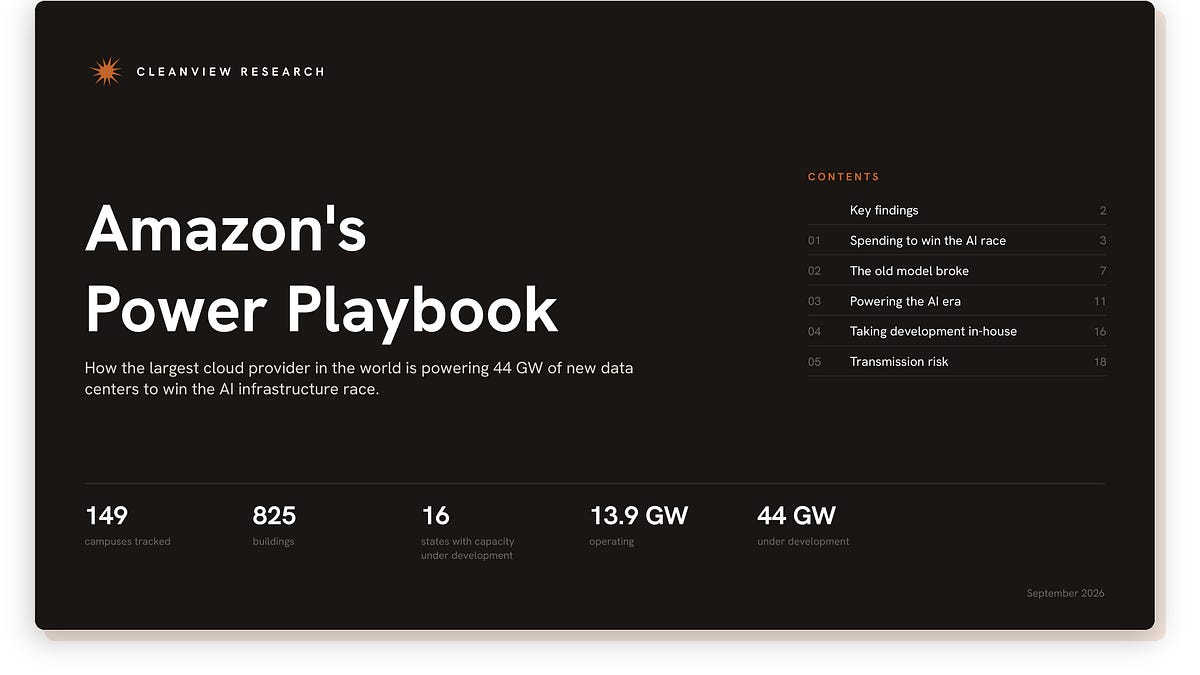
Last month, Cleanview broke the news that Amazon is planning to build a 7.65 GW natural gas power plant in West Texas to power a data center campus. In our latest report on Amazon’s power strategy, we identified seven more power plants linked to the company’s data centers.

Altogether, utilities and independent power producers are building 17.5 GW of new gas generation to serve Amazon’s growing power needs. That’s roughly 1.5 times as much power as New York City consumes at its peak in a given year.