“Leave this Europe where they are never done talking of Man, yet murder men everywhere they find them, at every corner of their own streets, in every corner of the globe.” --Franz Fanon

  • 31 posts
  • 22 comments
Joined 5 months ago
Cake day: April 30th, 2026
  • My political activities aren’t on the Internet. My argument, in good faith, it’s that bad people, like Brave’s dev, or Omarchy’s main dev, don’t deserve mindshare to spread their ideology that’s detrimental to the humanity. No single little convenience of something like a web browser or an OS when many alternatives exist can justify doing so. And those who advocate on the contrary should, at the very least, be scrutinized thoughtfully because, in the very end, they’re enabling the Curtis Yarvins and the Jordan Petersons, don’t matter whether willingly or not. Your actions enable the status quo.

  • lol, socialists don’t want to accommodate capitalism but overthrow it instead

    the working class potentially is on the same team but some are jailing already oppressed people in concentration camps, others are relying on that and many are egotistically snoozing through all of that and no gullible liberal talk about unity without conflict to make such unity possible is serious. Liberals shouldn’t call themselves socialist.

As a major disappointment to the open-source community, Siemens has decided to end – and close-up access – to the OpenRadioss project as the open-source version opened up by Altair Engineering under the GNU AGPL License back in 2022. This was an open-source version of the industry-leading finite element solver that Altair developed. Siemens acquired Altair Engineering last year and have now completely shut the door on OpenRadioss.

Originally from Altair, Radioss has been an industry-leading solver for analyzing crashes, blasts, and other purposes. Altair creating OpenRadioss was a huge milestone for the technical computing industry. It also had other effects like for myself in finally being able to benchmark with this (Open)Radioss code for CPU performance testing compared to the expensive licensing on Radioss itself.

To much disappointment, I find out today they have completely closed down OpenRadioss. The Siemens.com page now explains of OpenRadioss:

"OpenRadioss is transitioning to a new phase. Visitors looking for crash and impact simulation solutions can now explore Simcenter Radioss and the Radioss R&D program through Siemens. These offerings provide pathways for both production engineering and advanced research activities.
...
The OpenRadioss website is being retired and visitors are being redirected to this transition page. If you are looking for simulation software, technical information or opportunities to engage with future development activities, Siemens provides resources and programs to support those needs."

Even worse, it’s just not the OpenRadioss website being “retired” a.k.a. shutdown but they closed up their GitHub repository too. OpenRadioss on GitHub is now a 404. It would be one thing just to archive it and at least keep the open-source code readily available, but instead it’s been removed.

OpenRadioss 404

Siemens argues the OpenRadioss closure as for consolidating efforts:

"After four years of successful community-driven research, Siemens is entering a new chapter for the Radioss solver. To accelerate innovation and provide the robust support our global users require for production-grade simulation, we are consolidating our efforts."

Very disappointing to see from such a very promising technical computing project these past few years that was also very useful for real-world performance benchmarking purposes as my main interest in the project. At least for now I’ll continue with OpenRadioss benchmarking using archived local binaries for there not being any other superior free or open-source solution available. A major disappointment out of Siemens.


OpenMandriva has published refreshed installation images for ROME, its rolling-release edition, combining the distro’s current software stack in the new 26.09 snapshot.

OpenMandriva ROME 26.09 ships with Linux kernel 7.2 by default, while kernel 7.3-rc4 is also available for users who want to test the upcoming series. The distro also provides kernels in both Clang-compiled and GCC-compiled variants.

On the desktop side, KDE Plasma has been updated to 6.7.5, accompanied by KDE Gear 26.08.1 and KDE Frameworks 6.29. GNOME users get version 50.3, while LXQt moves to 2.4. Xfce remains on the 4.20 series, and MATE 1.28 now includes an experimental Wayland session.

The repositories also contain newer releases of Hyprland, COSMIC Desktop, Niri, Sway, i3, IceWM, Qtile, and several other window managers and desktop environments.

Under the hood, a significant change is the move to RPM 6.1. OpenMandriva has extended it with an optional %pgo section for spec files to simplify Profile-Guided Optimization when building packages. Several packages already use this feature alongside broader Link-Time Optimization.

The development toolchain has also moved forward. LLVM/Clang 23.1.2 is now the default compiler, GCC has been updated to 16.2, and the distribution ships glibc 2.44.

Graphics support comes with Mesa 26.2.3 and ROCm 10.0, including patches aimed at extending ROCm support to older Radeon GPUs. For NVIDIA hardware, the open NVIDIA kernel module has been moved directly into the kernel, avoiding situations where it becomes out of sync after kernel updates. The proprietary driver has meanwhile been updated to version 610.57.

Interestingly, another notable addition is Snap support. OpenMandriva already supports Flatpak with Flathub enabled and AppImage, but users can now install snapd from the repositories. The project stresses that native RPM packages remain its preferred format due to tighter system integration and reduced duplication.

The Plasma and LXQt editions have a new default browser. Helium 0.17.2 replaces ungoogled-chromium and is based on that project, restoring selected Chromium functionality without reintroducing Google services. OpenMandriva has adapted Chromium Embedded Framework to use Helium, allowing OBS Studio to use a CEF plugin based on the browser.

For gaming, ROME 26.09 includes Wine 11.18 with WoW64 support, Proton 11, DXVK 3.0.2, vkd3d 2.0, and vkd3d-proton. The Steam installer available through the non-free repository has also been updated to version 1.0.0.86.

Moreover, the release brings Qt 6.11.2, GTK 4.22.5, PipeWire 1.6.9, FFmpeg 9.0, GStreamer 1.28.6, Firefox 156, Thunderbird 155, LibreOffice 26.8, GIMP 3.2.4, Blender 5.2.2, and Krita 6.0.4, which has now moved to Qt 6.

OpenMandriva has also expanded the selection of local AI software available from its repositories, including Ollama, llama.cpp, Whisper.cpp, Stable Diffusion.cpp, ComfyUI, KoboldCpp, Aider, and several other tools. Many use the system-wide GGML library with GPU acceleration through ROCm, Vulkan, or OpenCL.

For additional details, see the announcement.

The refreshed ROME 26.09 images are available in Plasma X11, Plasma Wayland, and GNOME Wayland editions, with community-maintained LXQt, MATE, and Xfce spins also offered. Plasma and LXQt images are available for regular x86_64 systems as well as optimized znver builds for AMD Ryzen processors. An AArch64 server image is available too.

One exception is COSMIC Desktop: a ROME 26.09 COSMIC installation image was held back because of an issue with the login manager. Existing COSMIC users can continue updating normally, while new users can install it from the repositories.

Thunderbird 157 is now available, bringing a long list of fixes across mail handling, authentication, encryption, calendars, and account setup, along with a couple of new controls aimed at enterprise deployments.

One notable fix addresses an issue where Thunderbird’s status bar could remain active after an operation finished, potentially pushing CPU usage to 100%. The release also fixes cases where the message list displayed the wrong sender and where sent messages silently failed to save to the IMAP Sent folder.

OpenPGP users get several improvements. Thunderbird 157 fixes an issue that could cause valid RSA OpenPGP keys to be rejected and prevent encryption. Key discovery can now correctly locate replacement keys after an existing key is revoked. The client can also display remote content in OpenPGP messages encrypted with integrity protection.

On the authentication side, intermittent Gmail OAuth2 failures on Windows have been addressed, along with SMTP OAuth2 problems caused by large access tokens. Exchange users should see more reliable NTLM authentication after password changes. Another fix targets SMTP AUTH LOGIN failures following username challenges.

Moreover, Thunderbird could hang while waiting for an IMAP server greeting during account setup. Pending message moves inside the same IMAP account could sometimes make messages disappear. Both issues are fixed in version 157. Plus, manual IMAP and POP configuration is also simplified, as specifying a port is now optional.

Calendar and contacts users are covered too. The update fixes recurring events appearing beyond their configured end date, outdated CalDAV task content after synchronization, CalDAV invitations failing when accepted before a calendar synced, and some CardDAV address books failing to synchronize.

On the enterprise side, administrators now have two additional policies: DisableChat, which disables Thunderbird’s Chat functionality, and DisableFileLink, which disables FileLink. Plus, the built-in Thundermail add-on has been updated to version 2.0.16.

Rounding things out are fixes for disappearing inline images in edited drafts, incorrectly triggered message filters, blank Yahoo messages under certain MIME handler configurations, the Quick Filter keyboard shortcut, and various visual and UX issues.

For additional details, see the announcement.

Surprisingly, it’s LGPL v2.

The Sequoia PGP is part of the default seed, with the sq package in the main repo and officially supported. It’s said to provide a “modern, and memory-safe OpenPGP implementation”.

Ubuntu isn’t making Sequoia the distribution’s default OpenPGP toolchain. It ships preinstalled, but lives alongside the standard implementation.

However, the goal is to make Sequoia PGP Ubuntu’s default in the near future, with sq and sqv replacing gpg and gpgv.

For now, gpg will still invoke GnuPG, while sq (or an app configured to use Sequoia’s libraries) calls on Sequoia. Users can run e.g., sq sign or sq verify instead of gpg from the command line to try it too.

Canonical says adopting Sequoia will enable Ubuntu to maintain OpenPGP interoperability while benefiting from a “more maintainable and memory-safe foundation”.

It’s not the only Rust-related change in the new Ubuntu release, either. Ubuntu 26.10 ships a full set of Rust-based core utilities out-of-the-box, completing work that began in 25.10. GNU-versions of cp, mv, and rm are now provided by uutils.

Canonical’s engineers plan to ‘oxidise’ more foundational packages in future releases. A Rust rewrite of the Network Time Protocol (NTP) being eyed for inclusion as the default time sync client in Ubuntu 27.04.

The company is also a gold sponsor of the Trifecta Tech Foundation, paying €40,000 a year to help fund work on Rust software.

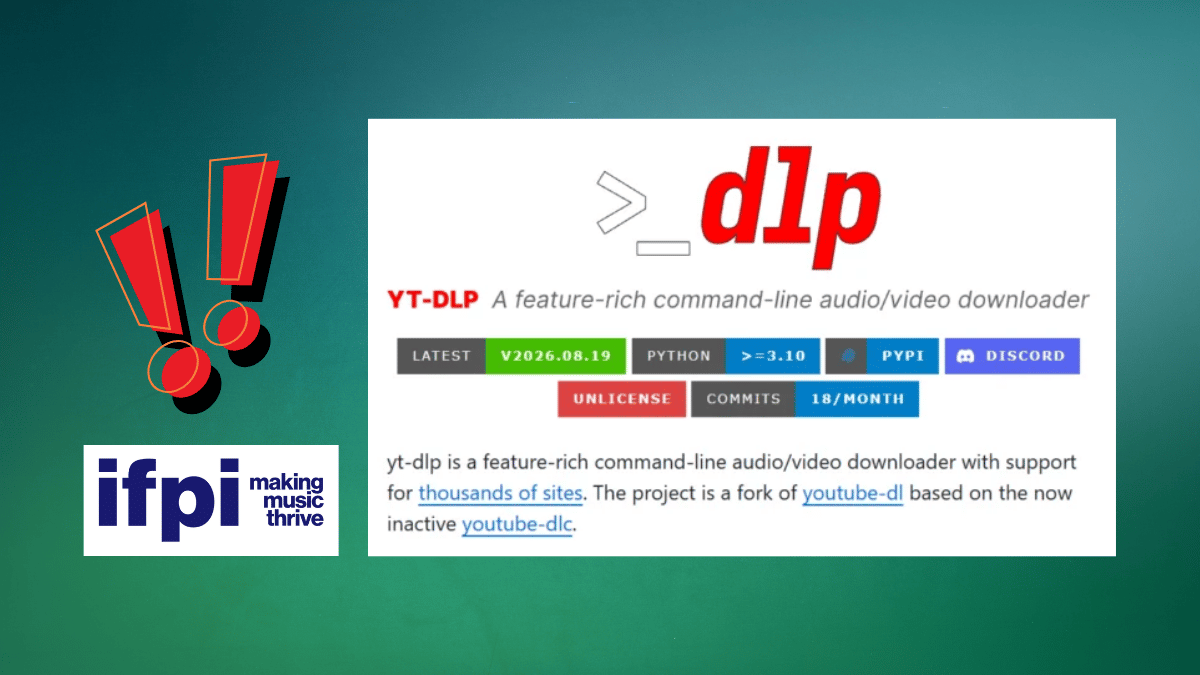
yt-dlp has over 195,000 stars on GitHub, supports thousands of platforms, and is actively maintained by a global developer community. Unfortunately, the IFPI would like to see it on the EU’s piracy watchlist.

Just so you know, the International Federation of the Phonographic Industry (IFPI) represents around 8,000 music labels across 70 countries.

In its submission to the EU’s Counterfeit and Piracy Watch List consultation, the group calls yt-dlp “a major problem for the music industry” and names four of its maintainers by their GitHub handles.

A Piracy Watch List?

Run by the European Commission’s Directorate-General for Trade and Economic Security, the Watch List identifies online services and physical marketplaces outside the EU reported to engage in or facilitate copyright infringement.

While it sounds serious, the undertaking isn’t meant to gather legal findings and does not mandate any form of direct action. It’s closer to a naming exercise intended to pressure operators and governments outside the EU into addressing the identified services.

The 2027 edition is being compiled from submissions received through September 2026, with the final list expected in Q2 2027. What does their submission say?

IFPI’s submission covers a wide range of copyright enforcement concerns, from AI music generators and cyberlockers to streaming fraud services and domain registrars. yt-dlp appears under the “stream ripping” section, grouped with commercial websites like Y2mate and Savefrom.

They describe the tool as an application that retrieves content by parsing web page data and interacting with platform playback endpoints, with GitHub serving as the primary delivery method for its source code, pre-compiled binaries, and installation instructions.

IFPI names four of the project’s maintainers by their GitHub handles: pukkandan, who founded the project and led it between 2021 and 2024, and some core maintainers mentioned in the project’s Maintainers.md file, like coletdjnz, bashonly, and Grub4K.

The same submission also flags X, Discord, Telegram, and Vimeo as platforms facilitating copyright infringement at scale.

It’s a tool, not a service

The Watch List, as described by the European Commission, targets online service providers and physical marketplaces located outside the EU. yt-dlp fits neither description in any conventional sense.

IFPI acknowledges this by noting that the project’s open source nature, its Unlicense licensing, and an extensive international developer community make it “difficult to contain and/or remove.”

From their point of view, there’s no central domain to block, no payment processor to cut off, and no hosting provider to strongarm into complying with a takedown request.

The source code is distributed globally and can be compiled by anyone with the skills to do so. But that doesn’t mean yt-dlp is a piracy platform.

It’s a command-line tool for downloading audio and video content, and categorizing it alongside dedicated ripping or piracy websites conflates a general-purpose downloader with services whose primary purpose is facilitating unauthorized copying. Closing thoughts

The Watch List has been used in connection with enforcement against commercial stream-ripping platforms before.

Y2mate.com and eleven other stream-ripping sites were shut down in Vietnam in 2025, and Y2mate had previously appeared on the list.

Before that, in 2024, a German court held the host provider for youtube-dl.org liable in connection with facilitating circumvention. This shows that grouping an open source command-line tool with those commercial services in the same breath does not, by itself, make the tool one of those.

Since 2010, F-Droid has been the go-to place for downloading free and open source apps for Android. Its client app is the one people interact with the most, and it has received many upgrades over the years.

But now it’s time for a massive rewrite that has emerged from more than a year of development and numerous test releases.

A comprehensive redesign

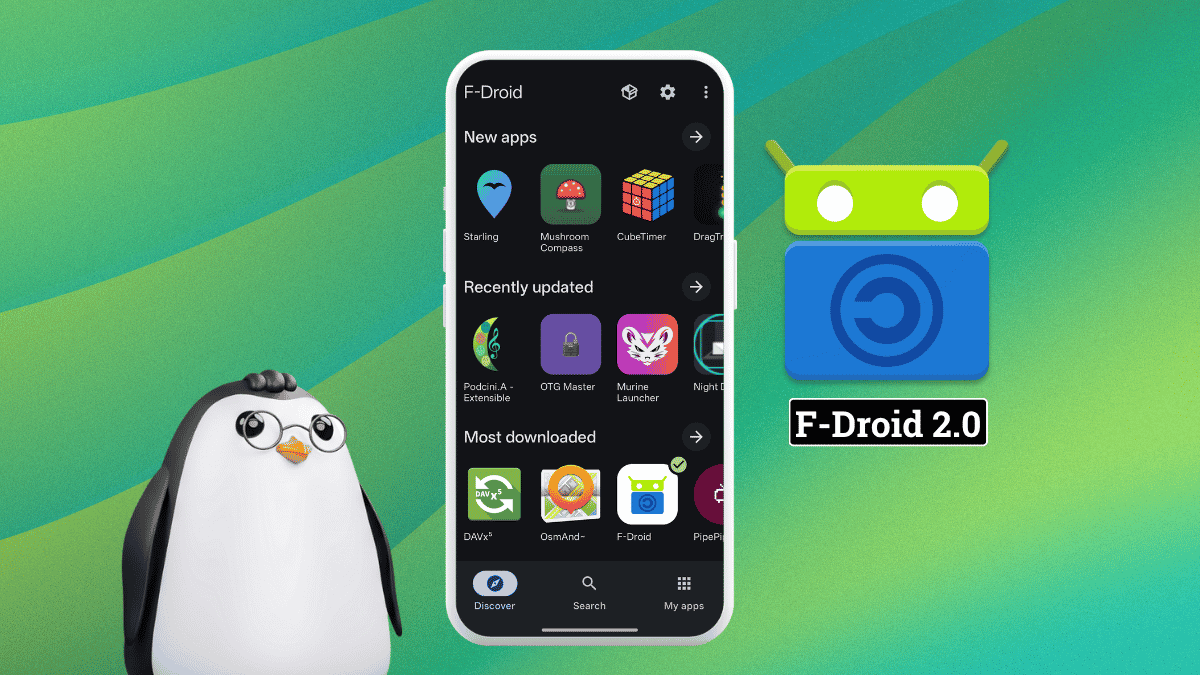
Kotlin replaces the original Java codebase, and the interface has been rebuilt on Jetpack Compose. The result is an app that follows Material Design throughout, so that it looks and behaves like it belongs on a modern Android device.

The app’s bottom bar now has three sections: Discover for browsing, Search for queries and quick access to categories, and My Apps for tracking installed apps, updates, and issues.

You will also find that the Settings menu has moved to the top-right, being placed alongside the new Repositories menu.

Coming back to the Discover page, it has been configured to highlight newly added apps, recently updated ones, and the most downloaded ones in the repository. Related categories are grouped together, making it easier to browse the full catalog without getting lost in a long list.

Search now handles categories, app descriptions, and translated content in addition to app names, and results for Chinese, Japanese, and Korean queries have improved. Your search history is also saved for future queries.

Filtering has been reworked too; results can be narrowed by anti-features, device compatibility, and category all at once.

What else’s changed?

This is how the old F-Droid app looks in comparison.

The app now checks for updates in the background by default, removing the need for the pull-to-refresh gesture that used to trigger repository scans. Of course the manual check is still available from the My Apps page once you go into the three-dot menu.

Similarly, the app hiding feature for changing F-Droid’s logo to a calculator app has been moved into the Settings menu under “App Icon,” and the Nearby app sharing tool has been temporarily removed.

Concluding their announcement, F-Droid stated that:

F-Droid 2.0 represents a major milestone, but it is not the end of the story. Rebuilding the app has given us a stronger foundation, yet there is still plenty of work ahead.

As the rollout reaches more users, we expect to learn a great deal from real-world usage. Community feedback has shaped F-Droid 2.0 from its earliest design discussions through many alpha and RC releases, and it will continue to guide future improvements.

A looming threat

Last year in August, Google announced that starting 2027, every Android app developer would need to register with the company, providing government-issued ID, signing key evidence, and a fee.

This way, apps from unregistered developers would be blocked from running on certified Android devices.

Of course F-Droid didn’t sit by idly; one of their board members, Marc Prud’hommeaux, launched the Keep Android Open campaign in response, which has since brought together over 70 organizations from 20+ countries.

Its signatories include big names like the Electronic Frontier Foundation, the Free Software Foundation, KDE, Proton, Codeberg, VideoLAN, LineageOS, CryptPad and the Tor Project.

Seeing that we are shy of the 90-day mark for this absurd lockdown to occur, F-Droid introducing such a major update only strengthens their stance of not backing down to Google’s strongarming tactics. Get F-Droid 2.0

This revamp is rolling out gradually over the coming weeks, so if you haven’t received this on your existing installation, just wait. For new installations, it is a similar situation, as the latest stable release is still v1.23.2.

On the other hand, if you can’t be bothered with practicing the virtue of patience, then you could download the latest 2.0 beta build from the packages portal.

TikTok has agreed to pay Alabama at least $100m and enact time limits and other restrictions for teenage users, avoiding a trial with a settlement that was modelled on Instagram-owner Meta’s recent agreement with US states.

Alabama described it as a “first-in-the-nation settlement” with a state in the sweeping litigation over social media’s affect on teen wellbeing.

A trial had been set to begin on Monday in the southern US state over claims by Alabama that TikTok misled parents about tools meant to shield children from harmful content.

TikTok’s settlement with Alabama mirrors safety provisions agreed by Meta, including a two-hour daily time limit for teens, restricted access from midnight to 6am, and suspending notifications during school hours.

It will also strengthen age verification, ban beauty filters for teenagers, and offer young users a non-personalised content feed.

Attorney general Steve Marshall hailed Friday’s settlement as “a great day for Alabama parents”. He said: “Tonight, they can rest easier knowing real protections are in place to shield their children from the dangers of social media addiction.”

Under the settlement, TikTok will send $100m to Alabama and could possibly pay up to $300m in total if 40 other attorneys general sign similar agreements with the company within a specified timeframe.

Alabama’s suit was the latest in a wave of litigation targeting social media companies across the United States about alleged harm their apps cause young users.

In August, Meta agreed to pay $18bn to settle a sweeping lawsuit brought by US states accusing it of designing Instagram and Facebook to get children addicted.

In addition, the Alabama deal includes a conditional restriction that Meta also agreed to: expanding the night-time shutdown period to 10pm to 7am if other platforms also commit to do the same.

“TikTok’s priority has always been fostering a safe and positive space where people can be creative, discover what they love, and connect with their community,” a company spokesperson told AFP.

“This builds on our commitment and core objective to continually enhance our robust safety tools to protect teens,” the spokesperson added.

More than a dozen other states, including California and New York, still havesuits against TikTok.

The company has previously settled cases against it that were headed for trial, including a Los Angeles lawsuit brought by a young woman and a suit from a Kentucky school district.

Meta, by contrast, has taken its chances in court – with bruising results.

In March, a jury in New Mexico ordered the Facebook and Instagram owner to pay $375m after finding it had misled the public about the safety of its platforms for children.

That same month, a Los Angeles jury found Meta and Google’s YouTube negligent in the case of a 20-year-old woman who said she became hooked on social media as a child, awarding her $6m.

Going to trial would have exposed TikTok to unprecedented public scrutiny of how it handles safety, with company documents and executive testimony potentially aired in open court.

Alabama originally sued TikTok and its Chinese parent company ByteDance in April 2025, alleging the app was engineered to hook young users “just like a sophisticated gambling machine”.

The state later narrowed its case to claims under Alabama’s Deceptive Trade Practices Act, focusing on whether TikTok misrepresented the effectiveness of features such as “Restricted Mode” and “Kids Mode.”

The lawsuit accused TikTok of falsely claiming it limits access to sexual and violent content for young users to have its app rated safe for teens in app stores run by Google, Apple and Microsoft and of misleading users about the Chinese government’s access ‌to US users’ data.

TikTok said it designed its platform with teen safety as a key priority and argued that section 230 of the federal Communications Decency Act shields online platforms from liability for user-generated content.

With Agence France-Presse and Reuters

Flatpak 1.18.4 has been released as a security-focused update to the popular application sandboxing and distribution framework for Linux, addressing six newly disclosed vulnerabilities along with several related hardening improvements.

Among the most important fixes is CVE-2026-97024, which could allow a malicious Flatpak application during installation to overwrite arbitrary files with either an empty file or a symlink. A related issue, CVE-2026-97023, could be abused to delete arbitrary files with elevated privileges.

The release also fixes CVE-2026-97025, an issue affecting authenticated OCI repositories. Flatpak now ensures authentication tokens used when downloading applications or runtimes are not exposed to other local users. CVE-2026-97026 is addressed by restricting permissions on temporary repository directories under /var/tmp/flatpak-cache-*.

Another fix, tracked as CVE-2026-97027, introduces stricter filtering of .desktop and D-Bus .service files against an allowlist of permitted fields. According to the developers, this prevents denial-of-service scenarios as well as unintended interactions with services running on the host system.

Flatpak 1.18.4 also resolves CVE-2026-97029, which could allow an application to send signals to a process group containing a parent process outside its sandbox. In certain circumstances, this could result in denial of service by terminating the user’s desktop environment.

Beyond those six vulnerabilities, the update refreshes the bundled xdg-dbus-proxy fallback to version 0.1.9, fixing CVE-2026-93676 and CVE-2026-94422. Flatpak also received additional protection against symlink traversal related to CVE-2026-97023 and CVE-2026-97024.

Finally, given the number and nature of the security fixes included, users are advised to install the update as soon as it becomes available through their Linux distribution’s repositories.

For more details, see the changelog.

As an initiative from NVIDIA for improving the Linux ecosystem outside the world of AI, they have been developing Display-Config-Server as a new solution to help enhance the Linux capabilities for complex display walls.

NVIDIA engineer Austin Shafer presented this morning at XDC 2026 Toronto around Linux on next-generation display walls: complex display setups appearing in TV production, theaters, and more. Many of these complex display walls today run on Microsoft Windows while NVIDIA is looking to improve Linux usage for such video/media walls.

The display walls running Linux today are typically on the X.Org Server still and making use of NVIDIA Mosaic display features. Using Wayland on its own for such display walls becomes more challenging due to the different compositors and other complexities. There is a path forward though using Vulkan Direct 2 Display “D2D” with the VK_KHR_display extension to let the Vulkan swapchain drive a physical display without any windowing system.

NVIDIA decided to engineer the Display Config Server to improve the Vulkan direct-to-display model by “owning” the displays and then leasing them out to Vulkan clients to avoid the need for every application to contain logic for handling display calibration and configuration. Display Config Server makes for centralized configuration, seamless handoff between clients, and making it easier for applications to implement.

The XDC 2026 presentation shared that NVIDIA is working to support the Display Config Server to run nested with a Wayland compositor. They are also working to improve how the Vulkan direct-to-display API can present on display walls.

The Display Config Server code is to be open-source via this GitHub repository but as of writing doesn’t appear to be yet publicly available.

Those wishing to learn more can see this PDF slide deck and the video embedded above.

Nice timing for a project named after Mocha. ✊

BSD licensed 🙄

The man leading GhostBSD, Eric Turgeon, has come up with Mocka, a new desktop for this BSD distribution that would eventually replace MATE. So far, he has unveiled the dock that will go into it, as well as some preliminary concepts and specifications that show us where Mocka will head next.

Existing users of GhostBSD don’t need to do anything now since nothing has changed on their machines. All of this is still under heavy development after all. 🤷

Grammar nazis won’t like this

In his search for projects named “Mocha,” the caffeinated drink, Eric made a typo and ended up naming his new creation “Mocka,” where every component has been built from scratch, taking in nothing from the MATE project.

He plans to replace one component at a time, reverse-engineering what MATE already provides until full feature parity has been achieved. Once this is complete, I assume that GhostBSD will default to using Mocka as its default desktop environment.

And this is not his first time carrying out such a major change. In February, he came to the conclusion that MATE was not ready for Wayland and GhostBSD would switch to XLibre to keep its X11 session intact.

That line of thinking also checks out with what Eric’s doing now.

The desktop’s first component, a taskbar-style dock applet for the MATE panel called Mocka Dock, is already out now as an alpha for early testers. It lets you open apps, view their thumbnails, bring them forward into focus, and manage multiple windows of an app—basically doing what a dock worth its salt should do.

People who have the skills can build it from source right now to see what it offers, while the rest of us will have to wait for it to show up as an GhostBSD package update. Though it is not becoming the default experience yet, you will have to manually set it using the “Add to Panel” button on the taskbar.

If you take a look at Mocka’s GitHub page, you will get a better understanding of what’s being worked on apart from the dock. There’s Mocka Menu, which has a proper PLAN.md file that lays out what work has already been completed and what’s to be done.

The document shows us how a meson build and schema work has been done, with a long list of work yet to be carried out. This would give Mocka the ability to show a menu with listed items, the ability to handle search and keyboard inputs, integrate with the dock, and much more.

Eric has plans for a settings app too. Once complete, it would give users a single-access point for managing their GhostBSD machine’s desktop appearance, network config, power management, keyboard layouts, and other UI-focused options.

There’s also a separate repo that hosts the code for Mocka’s official website. It is considerably behind in terms of development than the menu component we saw earlier and only contained placeholder content at the time of writing.

The project is hoping to ensure that these new Mocka components remain compatible with MATE so that users can mix-match during this transitional phase to a full Mocka desktop on GhostBSD.