I write science fiction, draw, paint, photobash, do woodworking, and dabble in 2d videogames design. Big fan of reducing waste, and of building community

https://jacobcoffinwrites.wordpress.com/

@[email protected]

  • 19 posts
  • 5 comments
Joined 3 years ago
Cake day: June 5th, 2023

Hi folks! Getting out of the google web environment has been one of our goals for a while and now that our big projects made in google docs are published and our next ones are still early enough that switching them over won’t break anything, it seems like a good time to make a start.

So we’re switching to Cryptpad. I won’t call this an informed choice exactly, though I’ve been using it for a while - I know there are other alternatives out there we haven’t tested. But it’s a start and sometimes that’s better than dithering while you try to find the perfect option.

So where can you find out ongoing projects?

The FA! Game Manual V2 To-Do List, which tracks all the changes we plan to make for the eventual second version of FA!'s main manual, can be found here. This is where we track everything from spelling and grammar mistakes to big rewrites to lore and game mechanics.

https://cryptpad.fr/doc/#/2/doc/edit/7m-TulkwFIcEtYrPqd h--XX/

The Fully Automated Adversary Appendix is a rough list of enemies from previous campaigns and a start at drafting some generic/example ones. FA! doesn’t require a Monster Manual the way some TRRPGs do, but we did find that new GMs (including me) were looking to previous campaigns to balance encounters, so Andrew and I figured we might as well centralize that information. You can find it here:

https://cryptpad.fr/doc/#/2/doc/edit/aoMa0DbOt48XUsdAk3TXj2S0/

The Campaign Template is a mostly blanked-out version of the original campaign docs I set up back when I was starting Buried Treasure. It’s meant to make it easier to start drafting your own campaign. It was actually one of the first things I moved to Cryptpad back when I was testing it out:

https://cryptpad.fr/doc/#/2/doc/edit/j5n8eMM2WARmjbvT-6yWqZwA/

The New Early-Timeline Revolutionary Module/Game, working title Semi-Automated is a project we’ve just started. We’ve been talking a lot about adventures we could set earlier in Fully Automated’s timeline, when society is in a sort of messy cyberpunk/solarpunk flux, balanced between revolution/recovery and disaster:

https://cryptpad.fr/doc/#/2/doc/edit/M6-Gxs6DRQPO2zoxF5Izx7ll/

I’ll edit this post as we move other projects over. There are a couple other modules and some in-progress adventures in development which could probably work fine in Cryptpad, though I’ll need to make sure with the folks working on them.

cross-posted from: https://slrpnk.net/post/42689778

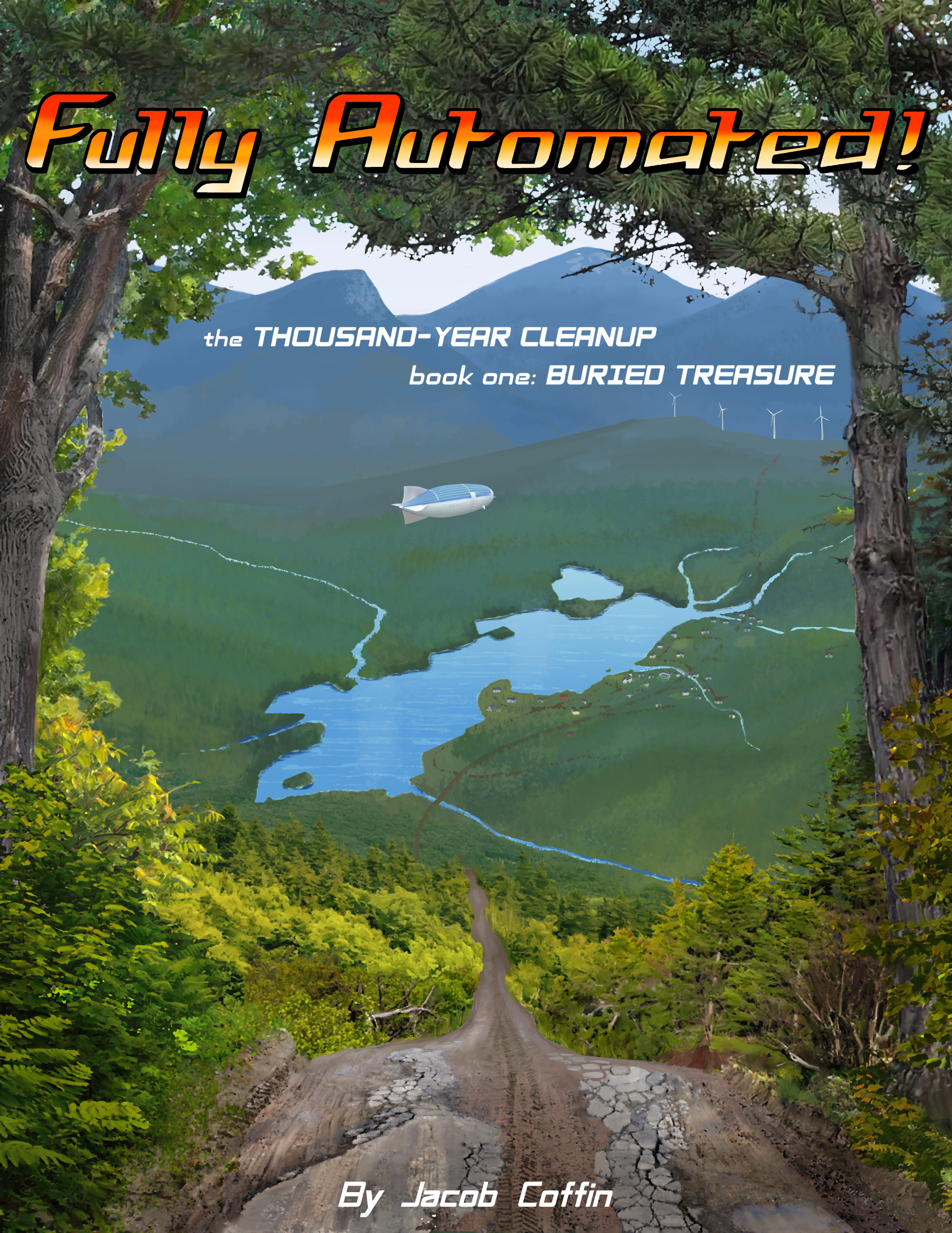
Hi, I’m Jacob Coffin, you might know me as the guy who posts solarpunk postcards, worldbuilding research, and other DIY/zerowaste projects sometimes. But that’s all been something of a side project for me for the last two, almost three years. My main project has been researching, writing, playtesting, and making art for a TTRPG campaign, and we’re finally launching it!

I should probably let the blurb we wrote introduce the thing:


A buried secret can stay dangerous for a long, long time… 

An investigator has a hot tip: rare waste. Dangerous to the environment and valuable on the reclamation market - a remediation co-op is already standing by to remove the contamination and restore the surrounding land. But time is running out to find it, as what’s left of the town is deep in a deconstruction boom. 

In Buried Treasure, players travel off the edge of the map to the mostly-abandoned town of Comity, New Hampshire to find an industrial dump site left over from the Global Climate Wars. But as work crews are in the process of removing the abandoned buildings and roads, there isn’t much time left before the trail disappears. It’s gonna be a challenge. But at least no one is going to be trying to stop them. Right? 

Buried Treasure is the long awaited second campaign for Fully Automated! Filled with interesting characters, locations, and plot hooks, this story has 20+ hours of content to delight solarpunk aficionados and newcomers alike! 

This adventure features: 

  • Original (human-made) art! 
  • An immersive rural solarpunk setting with resourceful homesteaders, radical work crews, and a village made from repurposed McMansions!
  • Maps, evidence, and an environmental sampling mini-game!

If that piques your interest, this is definitely for you! And if it doesn’t, you should check it out anyway because it’s free! As always, share any questions, feedback, and stories with our growing community on Discord, Mastodon, and slrpnk.net!


Like all the other solarpunk stuff I make, this campaign is CC-BY, so it’s absolutely free. You can grab the files on DriveThruRPG, itch.io, or just download them from my folder here: https://mega.nz/folder/HUEA3TyB#jB2zQnczETliHMKGIDeSyw

A while back I shared an idea for a future campaign I might try to write, focused on the work of Agreement Agencies. I think of the solarpunk adventure story plots as being divided into a few broad categories that provide both motivation and means to do adventure-ish stuff. The most straightforward one I think is Investigations, and a lot of our previous modules (including a Demonstration of Power and Buried Treasure) fall into this. Another is the Agreement Agencies - a type of organization in Fully Automated which focus on resolving conflicts and helping get things done in a way that works out okay for all parties. Per a draft of the game manual:

If a practice or enterprise impacts others (such as a large, noisy concert), or is so large that it represents a temporary opportunity cost for other people (such as commissioning a rocketship or major infrastructure) then agreement agencies provide assistance in mediating negotiations among stakeholders. These Agencies often loan members to other agencies to provide technical expertise to all sides or help de-escalate or settle disagreements. Members often specialize in ecological framing, estimation, surveying, contract wording, body language or simply history. These provide a kind of legal service, except that because legal tools to dominate or force conditions on people or groups are rare, these entities rely almost entirely on effective deal making.

I think these are cool because characters acting in this role (or supporting someone who does) basically have an active license to meddle in situations they don’t have a personal stake in, or to otherwise show up and work to resolve strangers’ problems, in a way that feels like the stuff of TTRPG adventures.

So here’s another Agreement Agencies idea, a bit smaller in scope than my last one:

A film troupe/studio/co-op wants to shoot a historically-accurate 2020s (or 2030s) picture, complete with gas automobiles, wide, paved autoroads, interstates etc. The directors’ vision calls for an emphasis on practical effects. The only problem is that 100 years in the solarpunk future, much of these bits of urban blight have been actively reclaimed, repurposed, or removed. Pedestrianized streets, parks, and tramways shape the urban landscape and a studio doesn’t have the same wealth-based power they did in the old world. Simply paying a lot of money to change a landscape to suit their film and leaving a mess behind isn’t an acceptable practice anymore. They need help finding or making suitable locations, sourcing pristine corporate-made antiques for set dressing and resolving some conflicts that have built up around some of the locations where the locals don’t want to see their neighborhoods changed for a movie. I think there’s also a good chance to look at ways blockbuster filmmaking might change when externalities, ecological harms, and waste are primary concerns.

I don’t have a lot of specifics drafted yet - I imagine the GM would provide a sidequest-style list of blocked scenes, missing items (perhaps they need to borrow antique petrol cars from collectors), etc for the players to work out, as well as one or two or big pre-existing conflicts to mediate. (Maybe the film group wants to pay to temporarily pave over the permeable, pedestrianized streets around an important historical building/set piece and some locals hate the idea). Andrew also suggested setting up some conflicts within the crew, perhaps they’re accidentally mirroring some of the conflicts in the story.

Perhaps to add some resources/negotiating power behind the film crew, it could be that they’re making a dramatized retelling of something from the revolutionary past which lead into the present day eutopia. If the film’s planned release lines up with a big anniversary/celebration of these heroic acts and has a lot of popular support, that might add some emphasis to the why it feels important that this be done a certain way.

One of the things I really like about this idea is that it makes contrasts between our present and the future an active part of the plot. The GM has plenty of opportunities to talk about how things have changed because those improvements are actively blocking the film crew’s goals. If we set things in the near future, it can also give the players a little personal distance and an opportunity to indulge an extra layer of (perhaps dystopian) worldbuilding of their own, in addition to collaborating on the present.

I’ve been working on a new page for the wiki, gathering up examples of the kind of bespoke, solarpunk systems people rig up when they live offgrid, in places with unreliable grids, or when they just want to reduce their energy usage.

https://wiki.slrpnk.net/writing:high_context_living

It’s far from being comprehensive or definitive on the subject, but it’s got some useful information and I find that it’s often worth it to set up these pages just to have somewhere to put new links and references as I learn about them!

If you have anything you’d like to add, either your own stories or links to blogs, forum posts, etc, please feel free to add them in the comments and I’ll copy them over to the page!

I don’t know how many poets we have in our community here but I wanted to extend an invitation from over on reddit - cromlygames is working on some kind of light hearted solarpunk poetry book and is looking for contributors! They’re a mod over there and a dev on the Fully Automated TTRPG team and this isn’t their first book project so I think anything they put together is going to be cool!

https://www.reddit.com/r/solarpunk/comments/1vf6qn3/i_want_to_compile_a_happycozyfunny_poetry/

It’s an idea I can’t shake. I love poetry, but I’m pretty miserable at the moment. I can’t handle the angst of https://ypn.poetrysociety.org.uk/features/young-poets-on-climate-change-the-power-of-being-a-young-writer/

So, be the change you want.

I want to put together a set of light hearted poetry about places and characters (like Pam Ayres “who are you calling vermin”), but set in a recognisable solarpunk world. Poems that might be called ‘Overheard at the library’, ‘Ballad of Bike Bridge’, ‘The Agrivoltichian’s holiday’, ‘Lawnmower’s reincarnation’. ect.

Examples of the tone I’m hoping for:

Poetry about people and situations. Funny Snapshots.

Pam Ayres: https://www.youtube.com/watch?v=mYeVhBUhITI Allan Alhberg: https://childrens.poetryarchive.org/poem/talk-us-through-it-charlotte/

Grace Nichols: https://childrens.poetryarchive.org/poem/cat-rap/ Roger McGough https://childrens.poetryarchive.org/poem/funicular-railway/

Poetry about places and hopeful feelings: Matt Goodfellow: https://childrens.poetryarchive.org/poem/meet-at-the-horizon/

Andrew Fusek-Peters and Polly Peters: https://childrens.poetryarchive.org/poem/the-nighthawks-after-edward-hopper/

Laura Mucha: https://childrens.poetryarchive.org/poem/albatross/

Rough plan. Small paper book, 34 lines to a page. Submissions close end of Jan 2027. Send to [email protected] sbj: ‘solarpunk poetry book submission’ Plan A is all typset and made available for download, local print on demand (as we have done for Fully Automated RPG). Plan B is using laTex to set out as a foldable, bindable zine, and personally doing a limited print run for participants (postage from uk is going to suck).

What I need:

  1. share this to likely people, there’s a world out there beyond reddit.

I should probably set a dedicated website or something for this. Never done that before. If you can help, please reply here :)

if submitting, somewhere between 3-9 English language poems, ideally 6 with varied topics. This is to get variety so many different people can be accepted. 2.1) Ideally no poem longer than 100 lines, be kind to your editor.

2.2) Poems rated PG at worst. I want to be able to give a copy of this to my 12 year old niece.

  1. if submitting, include a very short blurb. This may or may not be your real name, I don’t really care. PLEASE include explicit permission for me to share your email address with other editors (UK GDPR). 3.1) If you are interested/willing to workshop poems with other entrants, please state so. I’d like to be able to link some like-minded people up together.
  2. if not submitting, but interested in getting a copy at the end, shoot me an email saying so.

This postcard was made as part of the 2026 Story Seed Library Art Collab, which was themed on Disaster Preparedness, Response and Relief. For my part of the collab I decided to focus on the disaster preparedness side of the theme, and specifically on levee removal, house shifting, and ceding unsafe land back to nature.

Humans have been building levees in my country ever since colonization - in a way they’re part of an unending campaign to ‘civilize’ the land, smoothing out rough terrain, straightening and containing rivers, filling in wetlands, and generally drying out the continent.

Prior to levees, river landscapes were often messy, complex, and full of food for birds, fish and invertebrates. They would spread and braid across a wide area, and their slow-moving, shallow channels formed sprawling wetlands full of native grasses and willows which provided critical resting and rearing sites for young salmon before they headed out to sea. These wide spaces could flood safely during storms, and they played an important role in slowing and cleaning floodwaters.

These shifting rivers and sprawling wetlands were generally inconvenient to farmers and other settler types, who prized floodplains for farmland and development. To protect their new territory from flooding, they built thousands of miles of levees along nearly every major waterway, constraining their movement until some looked more like canals than natural rivers.

This was disastrous for the species which had evolved to occupy the niches now buried under levees and fill but it also hasn’t worked out great for humanity. In a narrowed, straightened river, that surge of water has nowhere to go, and nothing to slow its movement. As climate change alters weather patterns, intensifying storms and worsening both droughts and floods, we’ve seen frequent levee failures as hundred- and thousand-year floods become routine events.

There’s a self-defense truism that “the best defense is not to be there” which I think applies in this situation.

Levee removal recognizes that this modern configuration isn’t working well for anyone, humans or the species we share our environment with, and seeks to restore rivers to something closer to their original configuration. This can be beneficial in two ways - it allows the river to safely spread into designated areas where it can slow during a flood and it allows for the restoration of habitats where native species can return and flourish surprisingly quickly.

In this way levee removal is part of a wider rejection of modern human landscapes. Flood- and erosion-mitigation tactics like sponge cities, beaver dam analogs, and rough mounding all focus on restoring or simulating preexisting conditions, and on slowing the movement of water and catching it in place, allowing it to permeate the ground again. And because these are the habitats most native species evolved to find their niche in, it’s no surprise that they often start to recover almost as soon as we nudge things back in this direction.

Making these changes is difficult though. It’s not just farmland behind these levees - the sad truth is that there are many places where homes were built, families raised, memories made, that were never really suitable for development (this will probably include wildfire zones soon) and we’re going to have to reckon with that in the coming decades, whether we’re in a solarpunk society or not. We’re already seeing the beginnings in our present with insurance companies refusing to cover some areas and floodplain buyouts where government agencies purchase flood-prone land, moving or demolishing any structures, and returning them to open space to restore and conserve natural floodplain functions. Some areas just make more sense as floodplains and wetlands, providing important habitats and giving the rivers room to safely spread and slow their movements than they do as eternally-imperilled developments.

So that’s where I wanted to set this scene. In the bittersweet work of returning a piece of the floodplain to its original purpose and removing the home that was there.

There is a lot being done to rewild this site. Work crews are digging out the levee and hauling it away (in real life this fill is often used to build another levee further inland, behind the floodplain). They’re removing the house which was built on this parcel of land. And they’re digging a channel to reconnect a wetland which was once part of the river system but which was severed by the levee.

The timeline here is obviously a bit compressed – shifting the home, removing the levee, and digging the channel to reconnect the wetlands would likely all be separate stages of work. I’ve jammed them all into one shot for expedience more than realism.

When the removal and contouring work is done, a crew will likely plant willows, cottonwoods, wapato or other suitable native species.

The house shifting was inspired by this levee removal project, where a structure on site was demolished to clear the floodplain. I don’t know the specifics of that particular building, what condition it was in, whether anything was salvaged (or was worth salvaging). But there are two alternatives to demolition which I’ve been trying to showcase in my work: deconstruction – the process of disassembling a building to salvage as many construction materials as possible, and house shifting, the work of physically moving a suitable structure rather than building new. Both can be wonderful solarpunk alternatives to demolition which make the society less extractive on its environment and reduce the amount of landfill space it requires.

I’ve featured house shifting in a previous picture but I wanted to make it a bit more prominent this time.

This would be a big day for these work crews. After weeks of planning and work, of emptying the home, disconnecting it from its utilities and foundation, removing a porch, and jacking it up so they can assemble a frame underneath, a flying crane cargo airship has finally arrived to hoist the house up into its hold to carry it away.

I imagine that they’re probably using a mix of house shifting and deconstruction along this river - houses which aren’t suitable for relocation, ones which aren’t structurally sound, or have slab foundations, or are seriously damaged by flooding are disassembled and salvageable materials and construction waste are both hauled away by truck. The house shifting is probably done to relocate occupied homes to safer places, or to move abandoned-but-habitable homes to removal lots where a new family can choose them.

The concrete foundation left behind could be broken up and dug out with an excavator, used as fill or salvaged as rubble (it could even be cut into blocks for easier reuse if they have a lot of time or labor available) or it could just be filled in with dirt from the levee and left alone. (It’s a bad place to have built a basement but I’ve lived in neighborhoods where half the houses were constantly running sump pumps because the whole place was built in a filled-in wetland so I don’t think it’s unrealistic).

You may have noticed a cargo airship in the upper section of the scene. I think modern blimps have helped us forget just how absurdly, sky-filling-ly large real zeppelins were, and the LCA60T (which this is based on) is bigger than most of those. Tremendous thanks to GrafZeppelin127 over on reddit for repeatedly pointing out when I under-sized it in my early drafts. I ended up having to add more image around the edges just to fit it in the shot

Moreso than usual, the airship for the task I’m depicting doesn’t really exist. The closest fit is probably the LCA60T, which is intended to work as a flying crane, but its cargo hold is long and narrow in the current designs. It could fit a mobile home or pieces of a modular home designed to be transported by truck, but it wouldn’t be a good choice for a larger structure. There are other airship designs with larger holds, like the Boeing Megalifter concept from the 1970s which had a cargo bay 40 feet wide and 40 feet tall, and about as long as the LCA60T’s and the Lockheed-Martin Rigid Airship concept from the 1990s and early 2000s which had a cargo bay 250 feet by 260 feet, nearly square. These weren’t flying cranes though, and they were both designed to use a mix of buoyant lift and aerodynamic lift which could likely make them a poor fit for crane operations (or at least mean that their capacity would drop while hovering).

For a while I’d been thinking that a flying crane could simply carry large cargoes dangling underneath its keel. It turns out that that might be true in a few narrow cases (such as when transporting assembled high-tension transmission towers, which are already optimized to reduce wind exposure), but most cargoes would need to be transported safely in the hold. Once I looked up the damage normal mobile homes can endure while traveling 55 miles an hour on a highway, and after reading about the USS Akron’s spy basket becoming a dangerous pendulum during its only test, I was even more convinced to rework the image. Something tells me that an ordinary stick-frame house would not do very well blowing around at high altitudes.

When it came to placing solar panels, I wanted to keep well away from any structure on the envelope which might need maintenance, leaving a sort of patchy layout not unlike solar panels on a household roof. I can’t promise that’s accurate, but I’m fairly pleased with the overall look. I read somewhere that panels would be reasonably efficient even pointing downwards, thanks to the high albedo of the clouds below/around the airship, but can’t find an exact source. I think with our current tech they wouldn’t be enough to drive the airship but could provide enough juice for slow maneuvering like station keeping, and cover other electrical needs onboard.

Hi, it’s been awhile since I photobashed art for the solarpunk postcard series (I’ve been busy on a couple other, larger-scope solarpunk projects I hope to share soon) but I have some time while we work through final edits and I wanted to get back into it.

I’ve done a couple other nautical solarpunk pictures but they were both about modernized tall ships on the open ocean and I wanted to do one focused on the kind of activity you might see in a harbor, big river, or along a coastline.

The biggest/closest vessel here is an electric cargo barge originally from the Netherlands. These close-to-the-shore cargo vessels are a good fit for electrification as they run shorter distances and can swap their shipping-container-sized batteries whenever they transfer cargo using the same cranes. This article goes into more detail though it’s a little out of date as much of what it describes is now happening IRL.

The house shifting barge was lifted from a photograph of a real project carried out by a company in Vancouver, Canada though this appears to be common on coastlines. I’m a huge believer in salvage and reuse and have featured deconstruction in a previous postcard, but I haven’t showcased the work of picking up and moving entire houses yet. House shifting is also done overland, using large flatbed trucks, but the width of the roadways imposes more limitations on how big a piece of a building you can move so some additional disassembly and reassembly may be required. I think a solarpunk society would strive to limit outright demolition to very specific circumstances where the structure and materials are truly unrecoverable, and to relocate buildings wherever possible so this kind of move might be a common sight.

I replaced the original lead tugboat with an electric one.

Closer to the opposite shore on the left, we have a cargo sailboat, or more officially, a steel-hulled, container-capable gaff ketch. I don’t know how practical it is but I really liked this design as soon as I saw it - the mixture of a fairly traditional design with capacity for a modern shipping container (or 1 TEU sized ‘bus’ module to serve as a passenger ferry) just calls to me because I like a good anacronism. One of the big advantages of ships and containers is scale but single containers will still have to be moved from whatever big port they’re unloaded at to their final destination, so I suppose this would be similar to a riverborn 18-wheeler truck. It’s primarily wind driven but also has some configuration of electric motors. If these are viable we might see a good many of them in the bays, coasts, and big rivers of a solarpunk society, if only because they can reduce externalities like pollution or unnecessary draw on the grid.

In the middle there’s a docked sailboat. Not much to say about that.

And on the right is a river cleanup craft. Hopefully a solarpunk society will produce far less trash overall, especially far less disposable plastic waste, and would recycle or dispose of it better. But there’s always something that gets away and water has a way of catching anything blown around by the wind. Waterborne trash might also include debris swept downstream in previous floods.

It’s more effective to catch this waste while it’s concentrated in waterways near human settlements than it is to try to find and collect it on the open ocean, so I wanted to show one of these boats at work. There are many designs, but I picked Mr Trash Wheel from Baltimore, MD because the design is whimsical and probably easiest to recognize.

As for the shoreline, I was inspired by a photograph of Troy, New York, where a neighborhood of brick buildings look out at the Hudson river over a set of parking lots. I wanted to do a quick background with a dense community with a lot of four to five story brick buildings (as they’re pretty sustainable/practical long term) with hints of forested streets and a big park/riparian forest buffer along the waterfront.

I’ve done one postcard about flood compatible cities and generally favor sponge city designs where applicable, but I’m not sure what the best answer is for old downtowns built right up against rivers, with reinforced shorelines already in place. Replacing waterfront parking lots with parks full of swales and other flood mitigation designs is probably a good start and those changes could also improve water quality in the river by trapping waste and filtering surface runoff, especially if any fertilizer/compost use is carefully minimized or eliminated. Perhaps the community has also bought up waterfront land nearby, removed levees and restored flood planes to give the river room to spread and slow. Levee removal can both mitigate flooding and restore important wetland habitats.

The amphitheatre-shaped recess in the embankment is intended to provide safe public access to the river. This is also kind of aspirational for me - canals, harbors, and rivers IRL often catch drainage from city streets contaminated with animal waste and vehicle fluids, overflows from sewers, outflows (legal or illegal) from various manufacturers and industry and even just fertilizers and pesticides from lawns. I’ve seen people swimming in all sorts of waterways I’d personally stay out of IRL, but I’d love to live in a society which was so conciencious about its impacts that the water downstream even from major cities remained safe and clean.

The other Fully Automated devs are working on a new set of chase mechanics. We’ve been jokingly calling the create-an-obstacle-behind-yourself move “Summon Fruit Stand” and every time we say it I picture a walking robot fruit stand plodding slowly into the way, blocking the route. I don’t need much excuse to make solarpunk art so I photobashed this scene.

Most of my solarpunk photobashes are researched in advance, this one was kinda off-the-cuff. I knew if I included a background I wanted a narrow side street climbing a hill, and was able to find that. I added some water permeable street surfaces and shutters for passive temperature regulation in buildings while I was cladding it with textures.

The robot design is inherently silly so I tried not to overthink things this time.

Speaking of the robot - I wanted something that said “my cabbages!” but couldn’t quite justify giving it a thatched roof so we get a questionably-better tiled roof robot instead.

I wanted its human companions to look like they were guiding it to a new location, aimed for a kinda casual, happy posture, like they have no idea they’re in the way.

Over on the Discord (I promise we’re looking into alternatives too) /u/PyropusSquantscale recently asked for examples of Wicked Problems you might see in a Solarpunk setting. These are problems in planning and policy that are difficult or impossible to solve because of incomplete, contradictory, or changing requirements that are often difficult to recognize. Problems with no single solution.

I’m not sure if I am hit the requirements with this one but I think it might shape up into a proper campaign someday so I’m transcribing it here.

For these issues, I think scarcity is a pretty critical element and for that I tend to default to land because even in a post-scarcity utopian future, nobody’s stretching the continents to make them any bigger.

This one was inspired by a photobash I’ve been working on for the opening of a FA campaign I hope to publish soon.

A railroad company once owned a right-of-way to build tracks, 30 miles long and twenty feet wide, it crosses hundreds of properties and even divides two lakes by building causeways straight across them. The sort of thing you can’t build anymore because environmental protections block this kind of work for good reason, and because all those landowners (stewards/caretakers in FA) will raise holy hell if you try to cut a strip out of their land and clearcut and level it.

So folks in our solarpunk future want to interlink these towns and villages with a train like they had back in the old days. The right-of-way and the long, clear, nearly-level, perfect-for-trains swath of land is still open. The tracks are still there. But the right-of-way is owned by the state and it was turned into a much-loved bike path now.

Reopening train service means cutting the trees back, fixing up the tracks, and most importantly, that people can’t ride bikes here anymore. And, of course, big, loud vehicles will once again be traveling through everyone’s backyard.

The abutters are already organizing to stop it, and they’re couching their protests in terms of protecting the bike path and environment because they know NIMBY isn’t the most sympathetic argument. They also have a lot of supporters from the towns and surrounding areas who legitimately love the path as it is.

On the other side you have people in five towns who want light rail service so they can travel reliably and ship goods to and from the outside world.

And in this corner, a surprise third contestant: a watershed protection trust for one of the lakes is concerned about the causeway the train will travel across - they’re afraid brake pad debris, fluids, etc will enter the environment and of course the watershed their well water comes from. They’re also concerned that the causeway will need repairs before it can return to service, and that these will violate the shoreline protection act and could disturb an endangered species someone conveniently discovered nearby

If you need more complexity, turn your eyes to the towns themselves. Trains need stations and the historical ones with good locations have been repurposed while the line was inactive. One is a town information stand and chamber of commerce location (easy to reclaim because it’s still owned by the town), one is a restaurant who’s operator absolutely loves it in its current form, one burned down and got replaced by apartments people have built their whole lives in, etc. And the railway turntable at the end is now the centerpiece of a popular public park.

Add in a larger society that has moved away from cars, past societal crumbles where the roads went unmaintained for so long you might as well rebuild from scratch, and a dense local population that really needs a way to reach (and trade goods with) the outside world and I think we’ve got a fairly tangled situation for a group of agreement agency mediators to try and resolve.

  • I’ve been making good progress on the Fully Automated! solarpunk TTRPG campaign! We got a group together to play it and we’ve done four or five sessions now.

    At first I’d been thinking of the play sessions as the cost of getting the campaign guide finished and out the door but I’ve been having an absolute blast running it. It helps that my players are awesome - two are devs from the game, one is an experienced player, and one joined recently but has been great - their collective knowledge has basically allowed me to run the story and lean on them for the gameplay. It’s worked surprisingly well.

    I’ve never GM’ed before, played a couple DnD sessions but that’s about it. But I’ve watched tons and tons of Actual Plays and read a lot of world building and session running guides because they were a good source for writing advice, so I guess I picked up some GM tricks a long the way. It’s so fun! And they seem to be quite enjoying it - it’s been lovely getting to watch them occupy this world I put together and we’re looking at doubling how often we meet per week.

    The sessions have been a great motivation for making more content and an awesome way to find gaps I need to fill. It’s going to be a much more thorough document after the rest of the playtesting.

    I’ve also made a lot of character artwork (in a kind of old comic book style) and an additional map for one of the main locations which has been very helpful.

    It’s just been great and I’m looking forward to working on it more.

I’ve been wanting to do more scenes of solarpunk ships. Shipping underpins a huge amount of our society and I think building a more solarpunk world will mean changing it in some really interesting ways.

Last time I did a ship in a storm, but I wanted to do something a little more bright and happy this time around. A month or so ago I was talking with a sailor on the solarpunk subreddit and I asked if there was anything they’d like to see in nautical solarpunk art. I was kind of looking for design ideas but what they gave me was better –an excellent list of experiences and details which stood out from their voyages, one of which was the way whales come right up to sail ships because they’re so quiet and the whales are curious. So I started looking for art of ships and whales to reference, and (of course) almost exclusively found of paintings of whalers killing and carving up whales (which put a kind of tragic tinge on that wholesome description of their curiosity). So I figured that was my next subject – I wanted to do a scene with a similar composition to those paintings, but with the ship very clearly hauling cargo, and the two subjects just sort of harmlessly crossing paths.

The trouble is that with a lot of ships (especially sailing ships), it can be hard for most of us to tell its purpose from a distance. Container ships are kind of the exception, so I started looking for the rare combination of sail ships that can haul containers, and sort of went down a rabbit hole as I learned more both about our current shipping and proposed designs. I ended up collecting so much information in the course of that reading that I’ve actually put together a second post just with information for solarpunk writers and artists who want resources for nautical solarpunk](https://slrpnk.net/post/14284744). I’m very much not an expert but I hope it hits the level of detail most folks need to get started and that it consolidates it nicely in one place.

By far the best luck I had with all that was in reaching out to the Naval Architecture subreddit, where I found a handful of folks with the patience of saints willing to answer my questions, provide all sorts of resources I’d missed, and who walked me through drafting this junk-rigged-cargo-ship-with-offset-masts design. I can’t thank Open_Ad1920and the others enough for all their help!

I’d started out unsure of whether I wanted to do a more traditional ship design to better match the old whaling scenes I was riffing on, or to lean in on some of the more modern concept art I’d found to better contrast it. I ended up taking the proposed windcoop container ship and changing it to follow recommendations from Open_Ad1920. They had a lot of interesting design ideas for a sail-based modern container ship and I basically decided I wanted to go all in on their dream design and see what it looked like, rather than copy a company’s concept art. I’m glad I went with a more modern design now, because I was able to make it look less sleek and more like a modern working vessel (with a paint scheme copied from some real life container ships). I think that reflects some of my goals in the postcard series of showing the less-pretty, industrial kind of spaces that underpin even a solarpunk society that tries to co-exist with nature.

Speaking of which, one of their recommendations was modifications to the hull of the ship to make it safer for whales. Whales are sometimes hit by ships (they sleep just below the surface and don’t know where human shipping lanes are). Some hulls are more dangerous to them than others. Ships with steep, sharp prows and bulbous bows are apparently especially dangerous for whales. If you search for ship hulls and whale safety, you’ll find an unfortunate number of photographs of a dead whale draped over one of those bulbs.

One of their suggestions was to change the prow of the ship so it was angled forward, with no bulb below the surface, and a much more rounded/blunt bowstem. This design will likely lose some performance benefits while underway but if it hits a whale I guess it’s more likely to sort of dunk them rather than to slam into them like an axe.

The notes post and this conversation go much deeper into some of the design choices, but there’s a few other interesting aspects to call out here:

As they explained it, cargo cranes aren’t as inconvenienced by masts as you might expect, but bridges built after the age of tall ships block a lot of important ports, so folding masts are necessary just to reach the dock. Junk rigs like the ones in the scene are apparently well-suited to folding and offer decent performance.

They also recommended placing the masts on the ship offset from the centerline, in a sort of zigzag pattern, two on each side. As they explained it, this gets more masts on the ship, without going extra tall or messing up each others’ lift over drag ratio. I’ve poked around and found a few examples of offset masts (on flat bottomed boats, proas, or catamarans) but not much like this.

Most of their other suggestions for reducing draft and maintaining control underwater are hidden by the ocean. To paraphrase their suggestions, “the vessel has either a lifting keel or daggerboards. It also has at least two rudders, if not more, to get sufficient area. The rudders might end up as transom-hung folding types to reduce draft and maintain good performance under sail. A long, thin rudder works best. Racing monohulls of all sizes have been built this way and they work well while avoiding rudder damage from impacts.”

The whales in the foreground are blue whales,just sort of swimming alongside.

Nautical Solarpunk:

edit: an updated version of this information is being maintained in the /c/writing solarpunk writing resource wiki here: https://wiki.slrpnk.net/writing:nautical_solarpunk

I’ve been reading up on modern sail ships and asking questions while working on some solarpunk sailing artwork. At this point, I think I have gathered enough information that it might be useful to someone else.

So if you want to include ships in your solarpunk story (even just mentioned in the background) or you’re looking for references for some artwork, take a look. I’m very much not an expert, but I’ve been pestering some of them, and collecting examples from the internet and doing my best to organize it. Hopefully this by-laymen-for-laymen approach will help make it accessible without leading you astray.

One thing to note up front: there’s a ton of variety here. Historical nautical terminology is remarkably chaotic – probably because most of it predates manufacturing practices that involved standardization. Highlights include the fact that ships can be classified based on size, sail plan, rigging, hull type, how they’re used, some combination thereof, or whether they have a figurehead or not. Modern sail-based freight shipping is still very new and I get the impression that the industry as a whole is sort of picking up old ideas and new ones and trying them in different combinations to see what fits. There are very few finished examples underway out in the world and I’m not sure we’ll know what designs are the absolute best for which use cases until a lot more ships have been launched and put to work.

That said, I think we’re definitely going to see a resurgence of sail and it seems like there’s a decent amount of interest and enthusiasm in the industry, even if many are understandably nervous about making huge changes when those changes involve incredibly expensive ships.

Why sail?

It’s the original zero-carbon (-ish, they deforested huge amounts of land and destroyed entire habitats to build ships back when) shipping and transportation system. We had the technology to move cargo and passengers using the wind to directly do most of the work, and we have the technology (metal hulls, automated rigging, satellite navigation systems, radio, etc) to do it much more safely than our ancestors could. Even if a shipping company isn’t motivated by regulations or pure environmental reasons, oil will get more expensive eventually and that will cut into the profitability of giant motor vessels.

How shipping might change:

Modern day shipping is extremely cheap but only when you limit the metrics you track to money. When you account for the pollution, the waste, it gets a lot harder to justify. A huge part of keeping modern day cargo shipping cheap is using the absolute worst fuel (bunker fuel, tar-like stuff left over after distilling and cracking petroleum, which is contaminated with everything the fuel they were actually making couldn’t include), as soon as they hit international waters.

I think a solarpunk society is one that cares about externalities.

I genuinely like the optimization and logistical advantage of using standardized, stackable shipping containers which fit on ships, trucks, and trains without the need to load and unload the cargoes by hand at each transition in their journey. That’s great stuff, no complaints.

What I wonder about is if the cost efficiency brought by combining containerization with ever-more-massive, bunker-fuel-burning ships has caused other problems. We ship cargo all over the world but much of the time, we do it because it’s so cheap to do so. Many of those containers are full of cheap tat that ends up in landfills after one use or no use at all. We ship raw material from one continent to process it on another, we ship that material to another so it can be shaped into parts, which are shipped away for partial assembly on another continent, and then again for final assembly. Is that efficient? It’s cost efficient. But we burn terrible amounts of fuel each time we do it, and we do it for so many things.

When you read through the handful of real sail ships operating today, a theme becomes somewhat clear – these early (for profit) ones at least are primarily transporting the same high-value or location-specific cargoes sail ships were carrying a hundred years or more ago. Wines, champagnes, and other liquors, raw coffee, raw cocoa, luxury goods like that. This is partly because they need to justify the up-front cost of standing up a whole new kind of shipping, because they’re often slower, and because there are already crew shortages even before getting into the specialized skillsets related to sailing by wind. So they’re currently prioritizing the kind of specialty products (that only grow in certain climates or need special skills or reputation to produce) that exist in one place with markets in others, where they can markup for greener shipping. As they expand, the range of products will no doubt expand as well - cargo ships used to carry all kinds of stuff. But even with massive fleets (to make up for the fact that it’ll be hard to make single ships as big as we have now for reasons I’ll get to) we probably won’t see shipping done as cheap as it is today. Generally I think this lines up well with solarpunk principles like building to your local environment using local materials, manufacturing things locally, and building them to last and to be repairable. Shipping would fit the things that have to come from somewhere else.

The motor to wind spectrum:

I think it’s safe to say that almost any ship is going to be some kind of hybrid between motor vessel and sailing vessel. What ratio of wind to other energy (electricity, biodesiel, hydrogen, bunker fuel) is up to you. I will say there’s potential for a timeline here, starting with the majority being modern-day cargo ships with sails bolted on saving around 20% of their fuel, and transitioning towards more numerous, smaller ships using more and more wind, until the bulk of the fleet is primarily-sail ships with auxiliary motors or engines for maneuvering in port and dealing with emergencies. And chances are good that ships from all over that spectrum will be sailing at the same time.

So what does modern-day shipping look like?

We should cover the current landscape a little so you know what the new stuff is competing with or building on.

Most of the sites I’ve read break cargo ships into a few big categories:

Container ships:

These are apparently the most common and probably for good reason. The convenience and efficiency of shipping containers allows for some real benefits. Cargo can be packed into a 20′, 40′ and 45′ long container, transported by truck or train to a port, loaded onto a ship, transported to another continent, lifted onto trains and trucks and not actually unpacked until it reaches its destination. When the alternative is people physically carrying stuff onto the ship and packing it into the hold, and carrying it out and packing it into a truck, you can see where there’d be some advantages. (Palatalized cargo is a sort of great middle ground that allows for better weight distribution in the hold (you want the heaviest stuff near the bottom so the ship is stable) and can be loaded very similarly to how containers are (you move the entire pallet, so it doesn’t get unpacked until it reaches its destination) but that’s not super relevant at the moment.)

The big modern container ships can transport 85 TEUs (twenty equivalent units) to 15,000+ depending on their size. So far the biggest primarily-sail design I can find can haul 100 TEU containers.

Putting sails on these is kind of difficult because they use the deck for cargo space and will have cranes loading and unloading containers whenever they’re in port. Apparently this isn’t as big an issue as I expected, but it’s still something to keep in mind, especially if there’s tons of rigging involved in the design of the sails.

There’s a ton of designs out there for adding big easy-to-use sails and kites to existing container ships in order to boost their efficiency and cut fuel use somewhat. They’re in use now and have some good info if you’re looking for hard numbers. I haven’t really covered them in these notes much.

I find container sailships to be the most interesting (something about the mix of old and new, and the fact that containers make the ship’s purpose visually clear) so I’ve got a bunch of examples of them below.

Roll-on roll-off ships:

These ships are used to transport wheeled cargo, things like private cars, industrial vehicles, buses, trucks, construction equipment, excavators, etc. They usually have a huge door in the side or stern and the vehicles can directly roll on and off the vessel. They seem to be a popular choice for full-sail cargo ships because they don’t need to worry as much about keeping the decks clear for loading and unloading. How well they’ll fit in a solarpunk world is up to you – some vehicles and wheeled equipment will undoubtedly have to be transported overseas but whether there’ll be enough to justify this class of ship is up to you. Neoline is a good primarily-sail example of this type, Norsepower is a more traditional primarily-fuel version.

Dry Bulk Carriers:

These transport solid non-packaged loose dry cargo in bulk quantities. Think wheat/grain, chemicals for fertilizer, cement, wheat, sugar, coal, iron ore etc. Some of the last sail vessels in operation were bulk carriers, like the Flying P-Liners, some of which were still transporting nitrates in the 1950s. Most of the modern sailships listed below seem to do at least some of this.

Tankers:

These ships transport large amount of liquid cargoes like petroleum products (oil, gas), chemicals, wine, juice, etc. in bulk. They are probably a good fit for a wider range of sail types since they don’t need to worry as much about keeping the decks clear for loading and unloading.

Reefer ships:

(Short for refrigerator) they’re designed to transport frozen/temperature-controlled cargoes, mainly in refrigerated containers. Food and perishable goods (fruits, vegetables, meat, fish…). I don’t have much info on these (except that I think a lot of the container examples should apply). I do suspect these would be one of the most challenging as they’ll need a lot of power onboard.

Considerations for sailing cargo vessels:

This info is mostly pulled from some excellent comments provided by the folks on the Naval Architecture subreddit, especially Open_Ad1920.

This is a simplified summary, there are definitely details I left out that you can find over there.

What kind of sails do you need?

The most obvious (to most of us) difference between motor vessels and sail vessels is the huge masts and sails on top. For cargo vessels, they seem like they should pose huge issues for cranes in the ports (in the case of containerized shipping) but apparently this isn’t as much of an issue with larger and more modern crane designs as I would have expected. The modern cranes lift their booms to allow tall structures past, then lower them to the working position. Apparently they already work right up alongside tall structures on modern cargo ships so masts should be similar.

Where masts pose a problem is with going under bridges. Bridges often block ports and rivers where sail ships would like to enter. Most all of our modern bridge and port infrastructure was built in the days after tall ships had been replaced by steam and motor vessels, but that means there are trillions of dollars worth of port infrastructure that would be blocked to anything with a mast.

This has been a major motivator for folding mast designs. Some sails are better suited to folding masts than others, so consider the routes and ports your ship would likely see, and whether it would need to get past bridges. Consider bridge height, the height of the mast normally associated with your ship height, and whether the mast needs to fold. If it does, consider which sails are well-suited to doing so.

  • Several modern/proposed designs like the Windcoop or Neoliner use rigid sails on masts that can apparently fold down.
  • Of the more traditional designs, junk rigs / Chinese lug sails / fully battened lug sails seem to be the best candidate for a folding mast and are apparently pretty easy to use. Hasler & McLeod for more info. They may use curved battens that flip to orient the curve towards the tack in order to make close-hauled upwind performance comparable to that of a bermuda rig. If you need to understand those terms in order to write your story at the correct level of detail, you probably either know them already or are about to dive in to the world of nautical terminology, in which case best of luck! Lots more info here.
  • Lateen or “crab claw” varieties fold fine. Unfortunately they’re not very efficient upwind.
  • I’m told a bermuda main sail with in-boom furling is also conceivably compatible with a folding mast but that hasn’t been done yet.

Water draft/how deep is the ship below the waterline?

Water draft is another major consideration for port entry. Ports and rivers are shallower than the open ocean and sailing vessels with reasonably good performance will have a deeper draft than an equivalent motor vessel. This is for two reasons that I think basically sum up to ‘preventing the sails from tipping the ship over’ and ‘preventing the wind from pushing the ship sideways’:

  • Ballast weight – the lower they can hang the ballast, the lower the vessel’s center of gravity. This makes it more stable against the tendency of the sails to pull it over onto its side.
  • The protruding part under the hull acts as a wing in the water, producing horizontal lift. This counteracts the sideways component of the forces generated by the sails when traveling upwind, or even perpendicular to the wind. Having this makes the ship safer by helping prevent it from getting pushed onto shores, rocks, and reefs by unfavorable winds. This extra lateral area is going to stick out way under the hull for hydrodynamic reasons.

To allow them to enter these ports, modern sail ships might use lifting keels or have a flatter bottom, no keel fin, with daggerboards to provide that control while being able to lift up and cross into shallower water.

How tippy is it?

Motor vessels can make do with a higher center of gravity and much lower angle of vanishing stability (AVS). This is the point at which the vessel will capsize and stay inverted, thus sinking it. That’s because they don’t have sails making it easy for the wind to tip them. Sailing ships tend to lean more while underway, so they can’t pile containers as high.

Containers also don’t allow for the cargo to be packed quite as densely, or apportioned particularly well within the vessel from heavy to light as you go upwards compared to other systems. You just get what you get. Heavier containers can be placed lower, but the overall packaging density is less so the center of gravity still ends up higher than with more piecemeal loading methods. Palletization is a good compromise that can still load a sizable vessel in acceptable time. So while there’s a bunch of interesting container sailboat designs, I think we probably won’t see something equivalent to the absolutely massive cargo ships transporting thousands of containers.

However, this is another place where folding masts can help – being able reef the sails and tip them down during bad weather provides additional stability/safety so the ship can be loaded to a higher center of gravity.

Examples:

This is a list of new, operating, and proposed sailship designs. I’m going to sort them from less-traditional to more-traditional as determined by me (a person who learned most of this terminology a week ago). There are a lot of traditional sailboat designs seeing a resurgence, with various modernizations ranging from basic stuff like metal hulls, on-board motors, and modern navigation and communication equipment, to fancier stuff like automated sails on rotating masts.

The Windcoop container ship - this one has heavily-automated sails with very little rigging, making it easier to load and unload cargo. It can haul 100 TEUs which is the highest number I’ve found so far. It appears to have been designed by the same folks who drew up this one https://www.dykstra-na.nl/designs/wasp-ecoliner/ which would have used dynarig sails. At time of writing, neither has been revealed or launched.

Neoliner - cosmetically similar to Windcoop (I think, anyways), this is a roll-on roll-off cargo ship with heavily automated sails which can fold down to go under bridges. This has also not launched yet.

The Anemos, an 81-meter ‘Phoenix’ class ship (I can’t find an equivalent historical type) with a thousand-ton capacity and some automation on the sails. It’s currently transporting cognac, champagne, coffee, and other high-value cargoes.

The SV Juren AE a 48-meter cargo vessel with an Indosail-Sailing Rig and a 300-ton capacity. It looks much more like modern ships to me, and has an interesting frame rig on the structure near the stern covered in solar panels. A few other ships have used the Indosail rig, including one of Greenpeace’s Rainbow Warrior Ships (I think the one the french didn’t blow up?).

The Harryproa (and any other cargo proa designs). These use hull designs borrowed from the outrigger sailing canoes of the Pacific Islands. Made from fiberglass using simple, modular molds, they’re intended to be easy to build and repair. One hull is intended to transport up to 10 tonnes of cargo in modular containers, while the other holds the crew quarters and ferry seating space for 25 passengers. It has a built-in tender (small boat) for reaching areas the main ship can’t, and for powering the main ship when it needs it. This may also be a good candidate for the river boat section below. https://www.harryproa.com/

The Iliens, a sail catamaran with a 68-passenger capacity traveling along the coast between Quiberon and Belle-Île in France. 
https://en.rochefortenterre-tourisme.bzh/offers/iliens-la-navette-qui-met-les-voiles-quiberon-en-4652240/

Grain de Sail II, a 24-meter, metal-hulled clipper ship with a 350 ton capacity, transporting wines, raw coffee and cocao following the trade winds. It looks somewhat more traditional in the rigging to me. https://graindesail-overseas.com/grain-de-sail-ii

https://gosailcargo.com/ships.html A list of designs for somewhat traditional (I think) sailboats designed to transport shipping containers, starting with a clipper and working down to small boats. I really appreciate the diagrams they provide with each ship description and feature list. I don’t think any of these have been built yet but they’re based on historical designs. I didn’t notice any mention of being able to lower the masts, but some other tall ships, like the USCG training vessel Eagle (a three-masted barque), have upper mast sections that can be lowered to squeeze under modern bridges so that might be an option.

The SV Kwai for an example of a motor vessel retrofitted with fairly traditional sails. This allowed it to visit ports that weren’t considered profitable for motor vessels. A reuse-focused solarpunk society might make a lot of similar retrofits.

Sailcargo – a company operating a small fleet of wood-hulled schooners. They have a fair number of photos to use as references, including some clever solar panel placement.

Tres Hombres - about as traditional-looking as it gets – an engineless, wood-hulled brigantine made in the 1940s transporting rum, cocoa, coffee and olive oil.

Vega - (a looks like either a galleass or a cutter?) built in 1892 and formerly used to transport limestone, bricks, pig iron and cement, it is still in use today, transporting free school and health supplies to remote islands in eastern Indonesia and to East Timor. More info here: https://www.hrmm.org/history-blog/sail-freighter-friday-galleass-vega-1892-present

This is far from an exhaustive list, if you know of a cool ship or design I should include by all means let me know and I’ll add it!

River Sailboats – here’s a few examples (real or proposed) which would operate on large rivers like the Hudson, hauling cargoes or passengers. (Here’s a neat worldbuilding idea I found in the IWSA Small Windships Publication – the term ‘Sail Freight’ is apparently more common in the US while Sail Cargo is more common in Europe – both terms seem to have gained popularity independently, but in the US it was mostly in the context of rivers and coasts while in Europe it seems to be more about ocean cargo. It wouldn’t be unreasonable for sail freight to come to mean transporting cargo on rivers (competing with trucks and trains) while sail cargo ends up referring to the ocean.)

Schooner:

https://www.scenichudson.org/viewfinder/carbon-neutral-shipping-on-the-hudson/

Sloop:

https://www.clearwater.org/the-sloop/history-and-specifications/

Gaff yawl:

https://gosailcargo.com/secret-40.html – hauling a single shipping container or a modular ‘bus’ passenger compartment.

For recreation, these could be cool to include: https://en.m.wikipedia.org/wiki/Moth/_(dinghy

The Eriemax canal barge https://www.shipshares.com/Eriemax%20Final%20Report.pdf

Known for its somewhat chaotic looking collection of sails, the junk-rigged schooner Summer Wind does tours of Baltimore harbour

Like the ships, these smaller watercraft will likely need some kind of motor for tight maneuvering, emergencies, lack of wind, and to work as their primary power in some canals (similar to the old sail-driven canal barges (sailboats intended to lift dagger boards and drop masts when they get to the canal but able to operate as sailboats outside it). Perhaps these could even operate as trolly boats using overhead wires for power when they get to the canal so they wouldn’t require dense onboard energy storage.

Other Wind-Based Propulsion Technologies:

Sails are cool but maybe you want something more futuristic or visually iconic. For that you may want vertical turbine/windmill ships, kites, or Flettner rotorships. 

These are all working technologies which have seen use IRL, but at this time, as far as I know, none of them are being used as the primary propulsion for the vessels they’ve been added to. There may be physics limitations that prevent them from ever being more than an auxiliary propulsion, I’m not sure. 

I left these off the list originally because I was focusing on vessels which could operate primarily by wind rather than relying on an onboard power source like hydrogen, oil, or batteries. But if your setting is rich with clean energy (or you’re writing in the messy transition to a more solarpunk world) then these have a few advantages over more traditional sails (which are probably why they’ve seen earlier adoption in modern-day shipping): they’re easier to use and they require less change in how the ship operates compared to sails. They require fewer changes in design (meaning they can keep building massive container ships on basically the same blueprints). Ships using these will sail more like a modern cargo motor vessel so they’re more of a drop-in upgrade rather than a major overhaul in design and operation.

Perhaps your ships stop while underway at charging platforms powered by offshore wind or fuel up on hydrogen generated cleanly using electrolysis, or fill up in port as they would now. Or maybe they still burn oil. With that in mind, these alternative systems may save fuel/energy or allow the vessels to extend their range with fewer stops.

Vertical Turbine Ships / Windmill ships:

These ships use huge vertical wind turbines to turn the propeller. This can be through mechanical transmission (think huge drive shaft) or electrical transmission (generator->battery->motor). I suspect electrical systems will be lossier but they do allow for storing the power to use later. They’re still figuring out the best designs/configurations, but Savonius turbines seem common at the moment. The big advantage here is they don’t change how the ship operates too much - and that they’re somewhat out of the way of the cargo. Most can tip down to go under bridges.

Rotorships

Rotorships use Flettner rotors (huge vertical spinning cylinders with disc end plates) and the Magnus effect to create some kind of sail effect. Lift is generated at right angles to the wind, to drive the ship forwards. I think spin speed is used for control but I’m not certain.

In order for these rotors to function as sails, they need to be spinning, so the ship needs another propulsion source for generating that movement (though doing so takes less energy than moving the ship with a conventional propeller). 

Similar to windmill ships, these tall narrow rotors are more or less out of the way of normal cargo operations, and can usually tip down to avoid bridges. 

Kites

Anyone who has seen Waterworld will recognize the power of launching a kite to pull their vessel. The big advantage (to modern cargo operators) is obvious here: the ship is essentially unchanged, everything operates as usual until they launch the kite, and they can say they’re wind powered and ‘green’.

The actual advantage over sails is that windspeed increases with height, allowing kites to develop more thrust than a conventional sail. Winds are also steadier and less turbulent higher up. But unlike sails, a kite cannot stay in position when there is no wind, and must be recovered and re-launched.

Current kite rigs can be sailed within 50 degrees of the wind, meaning they tack to go upwind, like a ship with sails. Kites can be adjusted manually or by an automated system. 

Battery ships?

Electric ships are looking much more practical than I would have expected - getting there seems to involve reexamining how we use ships, as well as adjusting to use battery tech that makes sense for ships (as opposed to cars) https://austinvernon.site/blog/batteryships.html

Edit: There’s a very interesting write up in cleantechnica which describes a process of electrifying first the ports, then inland and coastal shipping. This plan would use huge, swappable battery modules, which fit standardized dimensions similar to shipping containers. These can be lifted on and off the ships using the same cranes they use for all their other cargo, and can be charged in port. Other ships could be charged while waiting for cargo to be loaded/unloaded. https://cleantechnica.com/2025/05/24/beyond-the-harbor-electrifying-short-sea-routes-and-hybridizing-blue-water-shipping/

For river boats, there’s a very cool project trying to convert the fleet of diesel motor canoes used in the Ecuadorian Amazon to solar/battery driven electric systems: https://www.nytimes.com/2025/06/23/world/americas/electric-boats-ecuadorian-amazon.html (sorry I don’t have a guest link).

Other Solarpunk Ship Stuff:

Other types of vessel

This post is mostly about cargo but there’s a ton of sail-based passenger stuff out there. I’ve gathered a few examples and will add more as I find new ones:

A company called Star Clipper is operating three tall ship cruise ships, Star Flyer, Star Clipper, and Royal Clipper. These look like older style clipper ships to me so they might actually be using mostly wind. They seem to be very much operating in the cruise ship format, probably with some associated issues, but they demonstrate that passenger liners could still be viable (and can be quite comfortable) if a change in pace of life or available resources reduces the number of airplanes for that kind of travel.

Seacloud, another sail-based cruise ship

A company called WindStar Cruises also operates a series of cruise-ship-sized ‘motor sailing yachts.’ These have sails but I don’t think these actually rely much on wind, at best I suspect they’re closer to the cargo ships with rotary sails bolted on to save some fuel. One of the naval architects on reddit seemed to confirm this.

There are also smaller crafts such as the 38-meter Schooner Mary Day which can carry 28 passengers. This may be duplicate with the schooner example from the Hudson above, but it still represents the potential for sail-based water buses on both rivers and coasts.

River and harbour cleanup boats like Mr. Trash Wheel (even if you hope a more solarpunk society would have less plastic trash, storms and floods can wash all kinds of non-trash stuff into the rivers).

There’s also the scaled-up version of those (though stopping plastic in the rivers appear to still be the critical part)

Magazines and publications with lots of good info:

The IWSA Small Windships Publication has tons of info on the sub-500GT range of smaller vessels including more info on most of the ships from the examples section (so it would have been really convenient if that was the first thing I found!). You can get a downloadable version here. Developments of Note lists a bunch of goo ships starting on page 10 and Sources for Vessel Plans on page 71 are especially useful but it’s all cool stuff.

Journal of Merchant Ship Wind Energy – another industry magazine with all kinds of information you might need.

Wind Propulsion for Ships of the American Merchant Marine (an older resource I haven’t read yet but am including for completeness).

Cool sails!:

https://www.boatdesign.net/threads/the-design-of-soft-wing-sails-for-cruising.49425/

Dynarig sails if you want ultra-modern sailboats and ships (the entire mast rotates)

All the info you could want on the Indosail Rig

https://www.junkrigassociation.org/photo/_gallery

Whale Safety

Whales are sometimes hit by ships (they sleep just below the surface and don’t know where human shipping lanes are). Some hulls are more dangerous to them than others. Ships with steep, sharp prows and bulbous bows are especially dangerous for whales. If you search for ship hulls and whale safety, you’ll find an unfortunate number of photographs of dead whales draped over those bulbs.

One suggestion is to follow some cargo ferry designs and design the prow of the ship so it’s more traditional, angled forward so the deck is further forward than where the hull meets the waterline, with no bulb below the surface, and a much more rounded/blunt bowstem. This design will likely lose some performance benefits while underway but if it hits a whale I guess it’s more likely to sort of dunk them rather than to slam into them like an axe.

There are also ongoing attempts to map our whale activity and to ensure that human crews are both aware of their presence and actually making efforts to avoid them, but if you’re looking for visuals this might be worth considering.

Lists of current projects:

This event has a decent list of current modern sail ships, from basically-modern-cargo-ships-with-sails-bolted-on to completely modernized 90-100% wind driven ships, to largely historical designs still in use.

https://www.wind-ship.org/archived-site/membership/ This organization lists its members, many of whom are related in some way to modern sailing vessels. Lots of good examples.

As I said up front, I’m not an expert. If you notice any errors, omissions, or just have a cool link to add, by all means let me know!


  • I haven’t done much on the campaign - my big project this month was researching and making the photobash of a more flood-compatible city.

    I’ve also been reading about modern sailing ships, including having a great conversation over on the naval architecture subreddit. My goal is to both make a new photobash of a cargo sail ship at sea, but also to write up what I’ve learned to consolidate the info and links for other solarpunk writers/artists. That’s part of a new thing I want to do - trying to make resources that make it easier to make solarpunk stuff.

    Edit: I did talk with an expert I know about testing sites for contaninants and got a list of tools and procedures they’d use in real life, so I now need to figure out how to abstract it in an interesting way (and that reflects the goals of the players in the game).

This is a little different from my other photobashes in that this one can’t really pass as a postcard. I ended up having so many things to include in the topic of flood-compatible cities that the only way to fit them all was to keep expanding the canvas. I think I have enough for a second picture (and possibly a third), but we’ll get to what’s missing in a moment.

So awhile back, I stumbled on to this discussion on reddit about what solarpunk might look like in a wetland area (and what it’d mean for cities built in wetlands). I very much believe that solarpunk will look radically different based on location, with infrastructure, routines, fashion, etc, being carefully tailored to fit climate, local weather, and the available materials, so this really caught my attention.

That discussion lead to this one, and this one, then this one as well as this conversation back over there plus several good chats on the Fully Automated and Solarpunk Hub discords.

I received a ton of awesome input which I genuinely couldn’t have made this without. Thank you! Most of the ideas here came from those talks. Even when people disagreed with each others’ suggestions, I tried to include them in the scene if I could make them fit.

The basic idea is for this to be a city that expects to be flooded regularly. One where, if the water rises a few feet seasonally, everything stays basically the same, and if a huge storm rolls in and swamps the whole area, people grumble about it, but can mostly still go about their day (using things like elevated walkways). The lower portions of buildings are used for third place activities that can be packed up and removed when forecasts predict bad weather (like marketplaces) or which use sturdy, permanent structures which can be hosed clean later.

There’s an argument to be made that the best answer to building cities in swamps is the simplest: don’t do it. And if you’ve failed that step, then you shouldn’t rebuild when whatever you build inevitably gets flooded.

I think there’s a lot of reasons to push back on that. Most major cities are already built on waterways or on the coasts due to the value of those locations for shipping and industry. Some are already below seal level, others are likely to be in the future as climate change worsens. These places house millions of people, they represent home, historical legacies, and preserving them helps preserve the cultures and communities of the people who live there. Lots of cities are looking for answers to rising water, and I’d love to see what solarpunk versions look like.

Sponge city tactics came up a lot in our discussions but we struggled to find ones that fit for a city (like New Orleans) which are at least partially located below sea level. If I expand the image to the left, I think I can definitely include a few, but generally, the water needs somewhere to go.

That said, I think this scene fits a tight shot of a much larger take on sponge city tactics of slowing water and absorbing it where possible.

Our current society has spent a lot of resources on straightening rivers for shipping and building dams and levees to shunt extra water downstream, to make it the next town’s problem, rather than suffer floods themselves. Farmers don’t want their fields washed out or polluted with debris so they build more levees and so on and so forth.

I think a solarpunk civilization might accept on some level that rivers are going to meander, they’re going to rise seasonally, and they’re going to flood the flood plains they’ve always washed over, and it might build with those expectations in mind. A solarpunk setting might adjust itself to coexist with the weather and floods rather than use huge infrastructure projects to try to keep them away.

The admittedly thin backstory I’ve got in mind is that this was a city which frequently flooded, and where some of its lowest areas (possibly mostly abandoned already due to uninsured damages and unlivable conditions near the collapse) were ceded to the water but not surrendered altogether. People built some structures higher than the water is likely to reach, and everywhere else, they float on it in boats, float houses, or even large rafts which contain small neighborhoods. They farm locally using floating gardens, hydroponics, Chinampas, and more. This isn’t a pristine wetland that’s been colonized, but a flooded neighborhood which has been partially rewilded.

I pulled in a few different living-with-water concepts in for this one:

  • The lifted buildings are an upscaled version of the lifted houses you can find all along the US Gulf Coast, intended to survive storm surges and floods during hurricanes.
  • I based the covered upper walkway on the iron lace balconies found on some buildings in the New Orleans French Quarter. It’s not quite the ‘correct’ use of the design, since they don’t traditionally span from building to building, but I thought it’d be a nice reference. The goal here is that if the area really floods, and the ground level is unsafe to traverse, people still have a way to get around. For safety purposes, I figure each building needs a ladder on each road to access the upper level in an emergency. For accessibility, I included frequent, standardized elevators and 15 degree ramps.
  • I used this amphibious bus design because it looked more municipal than the DUKW style duckboats many cities have for recreational purposes. Credit to Cromlyngames for suggesting this idea (and then making this 3d model about it). I suspect the amphibious design would be harder to maintain than a normal bus because of the sealed hull, but perhaps some of the efficiencies and practice that come with a larger, standardized fleet would help.
  • Dutch-style floating houses (these exist all over the world but I referenced dutch ones while making this scene). These are just meant to be towed into place and parked. Unlike the houseboats which are more boat than house and can travel as they want.
  • A Bangkok-style water bus – the idea is that the flooded zone is likely somewhat shallow, with deeper waterways intended for transit between neighborhoods of floating houses, large rafts supporting small neighborhoods, and through rivers and canals in the dryer parts of the city. If I do another scene, I’ll try to include a transfer station where passengers can switch between boat and an elevated train.
  • Waterways with restored eelgrass for manatees. I wanted to show some of the work that’s been done restoring rivers in the US south.
  • Chinampa agricultural system (farming on artificial islands) this is a pretty ancient farming practice from Mexico and Central America, which is still in use in some areas, and I’m still learning about it. I’ve done my best to get the scale and composition of the design correct. Some of the trees might be a bit overlarge, but they wouldn’t be planted very densely.

Other notes/elements included:

  • There’s a Savonius wind turbine attached to one of the dolphins (poles) for the dock. I imagine this probably isn’t supposed to be there, since it could get in the way during a high flood, but perhaps there’s not much enforcement or its the subject of a disagreement.
  • Awnings and porches to shade windows and balconies and buildings. The simple solutions work.
  • The hospital in the background would need to be able to operate during a flood, and to have water access (possibly via canals) so that people with only boats can access it quickly, in addition to road access.
  • The climbing wall probably isn’t ideal, as you’d want open spaces between the pillars if the flood will have a current. This was kind of an art decision - I needed a type of tall, narrow third place to include that would demonstrate its use even with the bus in the way and that seemed like the best option I could think of. Climbing walls are often made with wood frames and plywood – this one would have to be able to survive submersion, so perhaps it’s made from thick sections of recycled plastic or something similar. My other plan was just some trees, to show that it was a park, but that wasn’t as clear.

Speaking of third places, here’s some other ideas we had for third places you could have under these buildings. Presented in no particular order:

  • Tide pools and natural landscape features
  • Parks
  • Dog Parks
  • Meeting rooms
  • Lecture spots (could double as a bring-your-own-movie movie theater)
  • Squash courts
  • Playground (depending on the design)
  • Planetarium?
  • Speaker’s corners
  • Booths for food trucks or downstairs seating for a lifted cafeteria
  • Parkour course
  • Roller rink
  • Laser tag/paintball arena
  • Fresh water reserve tanks (firefighting, heat sinks, municipal cleaning as well as last reserve drinking water post major floods
  • Possibly storage for flood-tolerant stuff like scaffolding

Things I’d like to include next time:

  • Floating neighborhoods in the style of the floating islands of the Uros on Lake Titicaca (this would take a fair bit of space and a lot more reading)
  • A transfer station where passengers can switch between boat and an elevated train
  • Amphibious emergency vehicles

This image, like all the Postcards from a Solarpunk Future, is CC-BY, use it how you like.

Hi, I just wanted to say thanks for all your help on my previous question planning art of a more flood-compatible city! I’ve tried to include everyone’s suggestions from last time, plus everything from here, and discussions on reddit and discord.

I don’t plan to clutter up the community with any drafts after this one, but I was hoping to get one more pass with my current sketch since its based mostly on your ideas. Is there anything you’d like to see added or changed in a depiction of a city that’s built to flood? Thanks again!

  • I’m still working on the adventure module for Fully Automated! but I’ve definitely slowed down a bit. I know someone who does environmental restoration IRL so I want to work with them to add more information on testing sites for contamination, and to maybe try and build out a minigame around it. Then I have to write up one set of characters (build out descriptions and personalities and goals for them) and then go through and start adding all the game mechanics stuff. Right now, the campaign is essentially system-less. You could drop it into anything from GURPS to FATE but you’d have to work out the character stats etc that come into play when the dice start rolling. My goal is to stat out all the characters I’ve written descriptions for (which in FA includes a bit more history than I’ve currently got for some of them) and to script the handfull of possible combat encounters.

    Outside of the game, I’ve finished a photobash of a solarpunk cargo ship and been doing research on other possibilities for solarpunk shipping. I’ve also had some awesome discussions here on slrpnk.net about things folks would like to see in scenes of ships, boats, and coasts, and about what they’d like to see in depictions of cities in wet areas (which many cities are or will be).

    Most of my solarpunk projects start with a sort of input-gathering stage these days.

    I’ve also been putting together a list of parts from cars which can be used in other (hopefully more solarpunk) ways. This is part of my ongoing attempts to get more reuse in solarpunk media - just trying to make including it easy for writers and artists.

    So that’s it, a lot of discussion, one bit of art, and some incremental progress on the campaign.

One of my ongoing goals is to emphasize reuse in solarpunk media – both through my own projects and whenever I get the chance while helping others through suggestions or editing.

There’s a wealth of stuff all around us which could be repurposed in creative ways, and solarpunk art and fiction has a wonderful opportunity to demonstrate that ingenuity and thrift.

A lot of that stuff is in cars. So here’s some notes I’ve pulled together from various online discussions and from many people’s recommendations in solarpunk spaces. It’s not exhaustive, its probably not all good advice, but it should be good enough for a writer to casually drop into a description of a room or workshop, or for an artist to include in the background of a scene. Something that shows that this isn’t a scratch-built future, that they’re repurposing existing stuff wherever they can.

Think of all the weird ways postapoclyptic movies dress the sets with misused items from the present – here’s a somewhat practical guide to solarpunk set dressing with the guts of cars:

The big stuff:

  • Depending on the vehicle, its frame (if it has one), axles, and wheels can be used to make a trailer, cart, or similar. (I’ve definitely seen trailers that were just the back half of a pickup truck with a tongue and hitch welded on.) Bonus: the bearings in car wheels tend to be better than those used in regular trailers.
  • The transmission from a vehicle could be rigged up to a wind/water mill to adjust rotational velocity of a sawmill or other industrial application. Some power tools, like lathes, use vehicle transmissions: https://www.practicalmachinist.com/forum/threads/truck-transmission-for-lathe.240574/
  • Steel leaf springs can be removed from their bundles (they’re long, flat pieces of steel stacked and bound together with strips of steel) and are favorites of blacksmiths for making swords and knives because of the type of steel used.
  • Earthships can be made with stacked tires packed with rammed earth: https://earthship.com/systems/garbage-management/

The Electronics:

  • Alternators can be used to generate a wide range of amperage and voltage, suitable for different needs, including (in a few specific cases) welding: https://diysolarforum.com/threads/diy-low-cost-generator-from-vehicle-alternator-alternating-generator.1843/
    • The terminology here is a little confusing – early cars had DC generators (sometimes called dynamos), then they switched to AC alternators. But modern ’emergency generators’ still use alternators hooked up to an engine. So if you’re looking for something to convert motion to electricity, perhaps to attach to a water wheel, a vehicle alternator (and some belts to adjust the speeds) could do the job.
    • Some caveats: suitable vehicle generators and motors will likely work better, and to get an alternator to work you may need to either include a power source of 12v to excite the alternator, or to to replace certain internals to include permanent magnets. You’ll need to mess with the gear/pulley ratio to get the right (high) speed too.
  • The electronics in most cars are usually all designed to run off 12 volts, which can be very convenient for a household with solar panels depending on their setup. If a household has a low-voltage DC battery bank (some do, some don’t) then dropping the battery voltage a few times to power car parts comes with a smaller efficiency loss.
  • These 12 volt electronics include things like the cab lights, headlights, radio/entertainment system, backup/surround cameras (perhaps for a security system?), all of which could be placed in a home on a circuit providing the same power they’d get in a car.
  • LED headlights make for decent grow lights. Different models hit different parts of the spectrum, but generally they’re sturdy, run cool, and don’t take much power. They might not be as fine-tuned for plants as a dedicated product but they’re common and probably not being used for much in a solarpunk society.
    • Alternative use: outdoor lights, indoor spotlights, light on a wagon, rickshaw etc.
  • A car air conditioner could cool some small storage room decently. With big living rooms, it would have difficulty https://permies.com/t/177638/Convert-car-air-conditioner-home
  • Cars have lots of small electric motors with various advantages and disadvantages: you can pull motors from the blower, power windows, and windshield wiper motors have a fair bit of torque and can be decent actuators for some projects (I’ve seen them included in robotics projects).
    • The blower and motor could be used for ventilation elsewhere.
  • Starter motors are tricky – they’re designed to provide a lot of sudden torque to briefly turn the engine, and not to run for a long time. So they don’t fit a lot of our usual use-cases for electric motors. I’ve seen forum posts that describe using them for hoists (like to lift heavy things) but that’s about it so far.
  • There’s plenty of wiring in a car which can all be reused as long as the gauge is correct for the new use.
  • Automotive Relays are used to enable a low amperage circuit to switch a higher amperage circuit on or off, making the control systems safer. One example given was switching on heaters in a thermal storage water tank. There’s a fair number of forum threads where people link arduinos to automotive relays to control things the arduino couldn’t handle on its own.
  • Car batteries have long seen alternative uses – they might be the one car part used most outside of cars. As vehicles go hybrid and electric, their bigger, more powerful batteries become more common. Even when they weaken overtime, the lower power density doesn’t matter much for fixed installations where weight isn’t a factor, so old electric car batteries show up in homes and local grid storage systems: https://www.motherjones.com/environment/2023/11/old-ev-batteries-solar-power-grid-backup-b2u/

Moving fluids:

  • Various pumps and tubing can be used for moving fluids (though the original purpose/contents will restrict what you can use them for).
  • The tubing, tanks, pumps, and other parts used for windshield washer fluid are probably the safest car-fluid-handling components to reuse for non-car things (with a lot of rinsing and cleaning): https://www.mountainbuzz.com/threads/reusing-wiper-fluid-jugs-for-drinking-water.97053/
  • Car radiators work well for heat exchange, their intended purpose whether they’re in a car or not. This can be part of systems for heating or cooling.
  • Copper brake line can also be used in heat exchanges.
  • Fuel and brake lines should definitely not be used for things like potable water. But you wouldn’t be using potable water for heat exchange anyways, so contamination from the radiators, tubing, or brake line won’t make much difference there.

Odds and Ends:

Cosmetic stuff:

  • Seats: couches, chairs, porch swing, etc, fabric, foam stuffing for stuffed animals.
  • Windows are tricky because the shapes are weird, which can make framing them difficult, but they could be set into clay or concrete or similar building materials.
  • Hoods, roofs, and body panels offer some large sheets of metal which could be used for sheds.

Last but not least, there’s always conversion to run on woodgas (something I’ve depicted in a photobash) for some limited uses, or conversion to electric. And if all else fails, you can always melt them down for your society’s steel manufacturing needs – electric arc furnace smelters running off a green grid, recycling, are about as close to zero emission steel as you’re likely to get, and the metal is already refined so I think you could get pretty tight control over the quality on the output.

But I hope you’ll consider some of the above possibilities too. The parts are out there, we might as well use them.

Thanks for reading! Like I said, this is by no means an exhaustive list, so if you know of something I’ve missed, or see something I got wrong, I’m happy to edit it!

Also available here: https://jacobcoffinwrites.wordpress.com/2024/09/04/using-every-part-of-the-car-a-resource-for-solarpunk-writers-and-artists/

I’ve been thinking about trying to depict some of the ideas from this conversation: https://slrpnk.net/post/12735795, using a sort of flat, diagram-like style similar to this old photobash:

Though a bit more complex. The obvious answer is ‘don’t build cities in swamps’ but we already have a bunch of them, and though I don’t live there I recognize that they have a lot of unique cultural and historical value and are peoples’ homes, so I’m interested in what a solarpunk-adapted version of these would look like.

At the same time, I know basically nothing about New Orleans or similar areas, have no background in civil engineering, and no qualifications to make this except for the capability to do so using an old version of GIMP. So I’d absolutely love to identify issues, places to make improvements, and things that are missing now rather than once I’ve spent days chopping up images and finessing them into something coherent.

So what’d I get wrong? What’s unworkable, out of scale, or dangerous? What style of buildings or cultural touchstones would you like to see? What kind of plants are missing?

I recently started making solarpunk postcards again, and I had a lot of fun with a quick scene of a solarpunk cargo ship (a steel-hulled, four-masted barque) in a storm. I’d like to do more but don’t yet have any strong points to make or designs I’m excited to feature.

So what would you like to see? What scene is missing from solarpunk art of humans interacting with oceans, rivers, lakes, canals? What weird idea, or old, practical design should make a comeback?

I can’t promise that I’ll make everything but I really do try to include as many suggestions as possible.

So far suggestions from reddit and discord have included:

  • Showing more of the mooring ropes and foundations festooned with underwater life (perhaps in another storm or low tide?)
  • Boats or ships with soft wing sails which are apparently good (in theory) when it comes to performance as they maintain their shape regardless of wind conditions.
  • edit to add: a clipper ship

I’ll state up front that I’m not a nautical kinda guy. I like to pick up terminology and learn but I’ve never sailed anything larger than a sunfish and I see the ocean maybe once every five years. So feel free to spell out practical considerations and realism stuff because I probably won’t think of it.

And thanks!

I’ve been wanting to do scenes of solarpunk ships and shipping for awhile now. I love reexamining old technologies and seeing if they could work again, mixed with modern advancements, especially in a society with different values, or one that uses more metrics than just money to make their decisions.

I’ve read about the various attempts to make container ships more green with massive sails and kites and alternative fuels, but I never really loved any of them enough to make art of them. At best, they seemed to promise that they might use somewhat less fuel in the future, but they seem committed to the basic container ship format because its so efficient (in cost) and because everything is optimized around it.

I was talking with some of the folks from Fully Automated! about future weather changes, megastorms and tsunamis (and the potential for tsunamis to set off undersea avalanches that cause more tsunamis) and the damage those could all do to ports. How all that carefully-optimized equipment, even the depth of the ports themselves, could be damaged suddenly.

I started to think about solarpunk ocean scenes again, and about smaller vessels (which could perhaps use the shallower ports) could operate largely by wind, more or less traditionally.

Can the concept of container ships fit solarpunk? I genuinely like the optimization and logistical advantage of using standardized, stackable shipping containers which fit on ships, trucks, and trains without the need to load and unload the cargoes by hand at each transition in their journey. That’s great stuff, no complaints. What I wonder about is if that cost efficiency has caused other problems. We ship cargo all over the world but much of the time, we do it because it’s so cheap to do so. We ship raw material from one continent to process it on another, we ship that material again so we can shape it into parts, which are shipped back to the second continent for partial assembly, and then for final assembly on a fourth. Is that efficient? It’s cost efficient. But we burn terrible amounts of fuel each time we do it, and we do it for so many things.

So I’m skeptical.

Alright, my complaints out of the way, what’s actually in this scene? We’ve got an offshore windmill and a steel-hulled, four-masted barque with what’s hopefully an open-source variant of DynaRig sails.

So what does that mean? I’m very much not nautical – as with most of my postcards I’m doing my best to combine a bunch of concepts I’m only newly familiar with, so I’ve tried to make sure they’re at least based on reasonable starting points:

Cromlyngames in the FA! team mentioned DynaRig sails, these kind of funny-looking sails that taper towards the base, with thick masts and curved yards. They’ve seen some limited use on expensive yachts, there’s some proposals/plans to use them on container ships, and do seem to work well from what I’ve read. Their main advantage is in labor-savings and safety – the sails apparently slide out from inside the masts following tracks in the yards, so nobody has to climb the rigging to raise or lower them. And the entire mast rotates to best catch the wind. This allows for a smaller crew, and less of the traditional risks.

Crom suggested that they could work with any square-rigged ship, and a quick perusal of some nautical and sailing forums agreed with that (and taught me what those were). I started reading about traditional maritime shipping, and eventually found a forum discussion about the potential return of sail to modern day shipping. A poster on there mentioned the Passat, a German Flying P-Liner, and I was delighted to learn that a whole set of steel-hulled sail ships were hauling cargo well into the 1950s. Heck, one of them was captured by New Zealand during WW2 and put right into service hauling construction supplies.

So I borrowed the hull. IRL, I’m sure there’s a ton of quality-of-life improvements ship designers and sailors could suggest for a modern barque, and I’m sure I’ve included some stuff that doesn’t belong, but I’m just happy to have found a sail ship that was still effective in fairly modern days. In fact, it looks like staffing (both the difficulty finding qualified crew, and changing laws requiring more crew than traditional) was a big factor in the end of their service, and that’s something I suspect the modernized sails could help with.

I’d like to do more nautical scenes, so if you have improvements or alternative designs, let me know! I think I might do one with an offshore windmill substation, a clipper ship, or anything else you think would be worth showing. I know there’s been a ton of tech and safety features invented and added to ships since the P-Liners were modernized, and I think those things could help shorten their journeys and improve their safety at sea.

Art stuff: usually, unless I already have a strong plan for the visuals, part of my research is looking up various real life postcards and other art of similar content for inspiration. People have made postcards of almost everything.

There’s no shortage of paintings of ships at sea – I started this as a peaceful, sunny scene, but eventually gave in and went for a dramatic storm instead. Maybe showing the ship in a storm weakens the point a little, but ships run into bad storms even now, with all our modern day early warning systems – you can see plenty of videos online of even massive container ships losing cargo from being heaved around by the weather.

And one of my goals is to show weather, seasons, and locations that Solarpunk art doesn’t often feature. Bad weather is a fact of life, and it’s likely to get even more wild as our climate changes. I’ve done a couple scenes of blizzards, but none of terrible rains yet.

Given the premise that this is a postcard from a solarpunk future, it might be a historical scene of a famous ship that survived a hurricane, perhaps in the moments when the storm blew it dangerously close to an offshore wind farm.

This image (and all the other Postcards from a Solarpunk Future) is CC-BY, use it how you like.